
Averstar Chemical Editorial Team Updated November 7, 2026
Glufosinate-Ammonium SL Herbicide: Formulation Buyer Guide
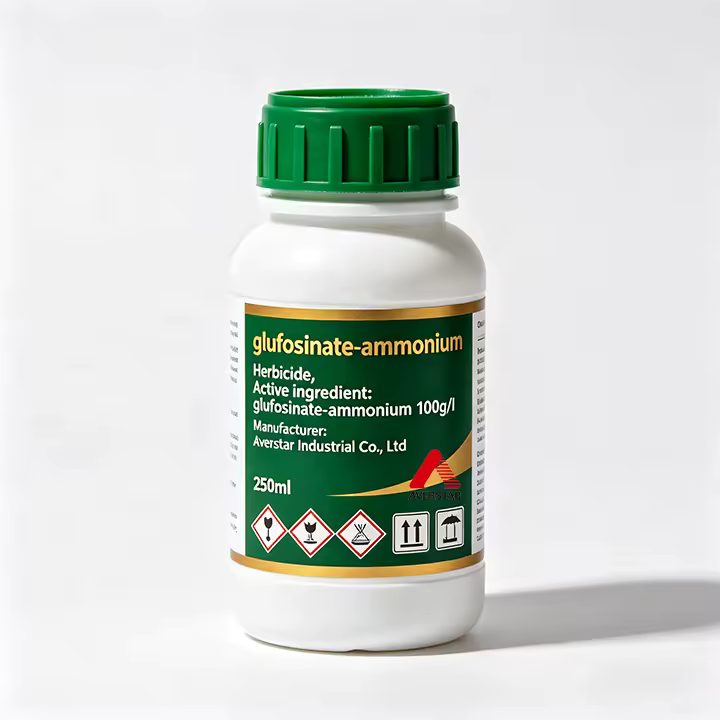
Glufosinate-ammonium is a non-selective herbicide, and buyers usually compare it with glyphosate when planning burndown, plantation or non-crop weed control. The two are not substitutes. Glufosinate works mainly by contact on green tissue it touches, while glyphosate moves through the plant, so the choice changes how a programme is timed and sprayed. The approved destination-market label decides where and how either product may be used.
Averstar's catalogue lists glufosinate-ammonium 100 g/L SL, 200 g/L SL and 20% SL. This guide explains how the product works, why coverage and weed stage matter, how to compare the three listings and which documents to request.
Quick answer: Choose glufosinate-ammonium for situations the label allows, usually burndown, directed sprays and non-crop areas, plus over-the-top use only in crop varieties bred to tolerate it. Compare the soluble concentrates on registration status, concentration unit and formulation quality, not on concentration alone.
What glufosinate-ammonium does
The University of Hertfordshire Pesticide Properties Database (PPDB) entry for glufosinate-ammonium describes a non-selective herbicide with contact and some systemic action, used for total vegetation control and against a wide range of broadleaf weeds and grasses. It inhibits glutamine synthetase, so ammonium builds up in the plant and photosynthesis stops. The HRAC global herbicide classification places glutamine synthetase inhibitors in Group 10.
Because it is non-selective, glufosinate damages any green crop tissue it reaches. In ordinary crops it is therefore used before planting, as a directed or shielded spray in plantations and orchards, or on non-crop land. Spraying over a growing crop is possible only in varieties bred to tolerate glufosinate, and only where the label covers that use.
Registration status differs by country: the PPDB record, for example, lists glufosinate-ammonium as not approved under Great Britain's pesticide rules. Some markets also register glufosinate-P-ammonium, the active isomer, which the PPDB lists as a separate substance with its own labels and rates. Confirm which active the destination market has registered before quoting.
Contact action changes how it is sprayed
A mainly contact herbicide only affects the leaves and stems it covers. Results therefore depend on spray coverage, on treating weeds while they are small and actively growing, and on the conditions at application, all of which labels usually address. Large or dense weeds may need a follow-up treatment. Glufosinate is not used for residual control, so weeds emerging after the spray are not controlled.
When preparing a product brief, record the target weeds by species and size, the spray equipment and water volume the grower uses, and whether the application is a burndown, a directed spray or a use in a tolerant crop.
Glufosinate and glyphosate are not substitutes
Glyphosate is a systemic herbicide in HRAC Group 9 that moves to roots and growing points, which is why it is used on established perennial weeds. Glufosinate, in Group 10, acts faster on contact but moves less within the plant. In some programmes glufosinate is used as a different mode of action where weeds no longer respond well to glyphosate, but the two cannot be swapped at a fixed ratio. Our glyphosate formulation guide and non-selective herbicide guide cover the comparison from the glyphosate side.
Compare the catalogue formulations
- Glufosinate-ammonium 100 g/L SL, 200 g/L SL and 20% SL: soluble concentrates, the format the PPDB notes the active is often supplied in. The active dissolves fully in water, and the formulation's surfactant system strongly influences how well the spray wets and covers leaves. Penn State Extension's overview of pesticide formulations explains how soluble concentrates differ from other liquids.
Watch the concentration unit. A value of 200 g/L is grams per litre of product, while 20% may be weight-for-weight or weight-for-volume; the two are not the same product unless the unit and density match. Also confirm whether the concentration is stated as glufosinate-ammonium or as the free acid, and keep that wording identical on the quotation, certificate of analysis and label. A stronger product means less formulated material per hectare, not a wider weed spectrum.
For quality checks, ask for the certificate of analysis together with the properties the buyer tests, such as solution stability and behaviour at low temperature, as described in FAO/WHO pesticide specifications.
A product selection checklist
- The registered active in the destination market: glufosinate-ammonium or glufosinate-P-ammonium.
- The permitted use: burndown, directed spray, non-crop land or a tolerant crop variety.
- Target weeds by species and size, and how quickly the grower can treat them.
- Concentration, unit and the salt or acid basis matched on quotation, certificate and label.
- Formulation tests: solution stability and low-temperature behaviour.
- The other herbicide groups already used in the programme, so glufosinate fits a rotation.
- Packaging, safety data sheet and translated label artwork for the destination market.
Build the inquiry around the intended use
Send the registered active, the concentration and unit, the intended use and target weeds, the packaging and the destination market through our contact form. For a first order, a pesticide sample evaluation plan helps compare samples against the agreed specification before scaling up.
Frequently asked questions
Is glufosinate-ammonium a replacement for glyphosate?
Not directly. Glufosinate acts mainly by contact, while glyphosate moves through the plant to roots and growing points. They suit different weeds and timings, and labels set their own rates, so one cannot simply replace the other at a fixed ratio.
Is 200 g/L SL the same as 20% SL?
Not necessarily. Grams per litre and percentage are different units, and a percentage may be by weight or by volume. Compare the products only on the unit stated in each registration.
Can glufosinate be sprayed over a growing crop?
Only in crop varieties bred to tolerate glufosinate and only where the destination-market label allows it. In other crops it would injure the crop, so it is used before planting, as a directed or shielded spray, or on non-crop land.
Authoritative references
- PPDB: Glufosinate-ammonium - University of Hertfordshire PPDB
- Global Herbicide Classification Lookup - Herbicide Resistance Action Committee
- PPDB: Glufosinate-P-ammonium - University of Hertfordshire PPDB
- Pesticide Formulations - Penn State Extension
- Pesticide Specifications and Quality Control (FAO/WHO JMPS) - FAO