
Averstar Chemical Editorial Team Updated August 30, 2026
Non-Selective Knockdown Herbicides: Comparing Paraquat, Diquat and Glufosinate Supply
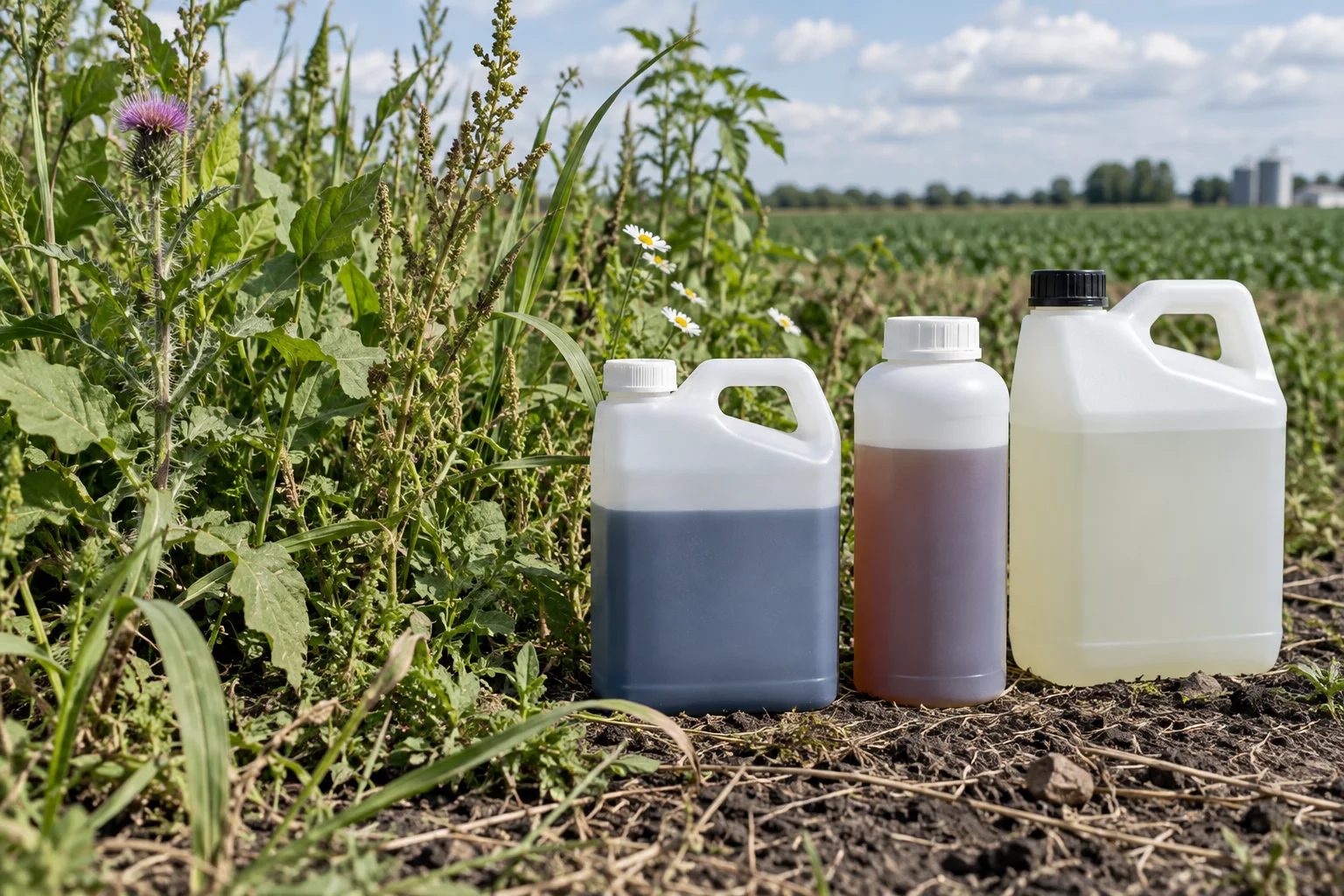
Non-Selective Knockdown Herbicides: Comparing Paraquat, Diquat and Glufosinate Supply
This guide explains how professional buyers can structure a sourcing decision when the request is simply “a non-selective knockdown herbicide”. It is an educational sourcing resource, not an application recommendation, product label or legal opinion. Product approval, label directions and commercial legality must always be verified for the destination jurisdiction.
Three actives dominate this request: paraquat and diquat, classified by HRAC in Group 22 as PSI electron diversion herbicides, and glufosinate-ammonium, classified in Group 10 as a glutamine synthetase inhibitor. They are not interchangeable — they differ in registration status, stewardship requirements, speed and spectrum — so the first sourcing question is not price but which of the three is actually registrable in the destination market.
Registration status decides the shortlist
Paraquat has been banned or heavily restricted in many jurisdictions, and where it remains registered, approvals often come with strict stewardship conditions such as closed-transfer packaging, emetic content and licensed-applicator requirements. Diquat and glufosinate-ammonium occupy different positions again, and those positions change over time. Confirm the current national decision for each candidate active before requesting quotations, because a cheaper offer for an active that cannot be registered is not an offer at all.
Averstar configurations in this segment
Averstar lists Paraquat Dichloride 276g/L SL for markets where it remains registered, Diquat 200g/L / 150g/L SL for desiccation-led programmes, and glufosinate-ammonium at three loadings: Glufosinate-Ammonium 200g/L SL, Glufosinate-Ammonium 20% SL and Glufosinate-ammonium 100g/l SL.
For diquat, note that offers may be quoted on the dibromide salt or on the diquat ion — the same acid-equivalent logic that applies to glyphosate applies here, so ask the supplier to state both figures on the certificate of analysis. For glufosinate, reconcile grams-per-litre and weight-percentage offers using the density on the specification before comparing prices.
Stewardship and packaging obligations
Where paraquat is still registrable, destination rules may prescribe packaging features, colouring and stenching agents, and training or distribution controls. Treat these as part of the product specification: ask the supplier to document exactly which stewardship features the quoted configuration includes, and confirm they match the destination registration file rather than a generic export standard.
When samples are needed for registration or laboratory verification, agree in writing what the sample represents: the batch, the formulation version and the specification revision. A sample drawn from a pilot batch does not prove that commercial shipments will match, so tie the commercial contract to the certificate of analysis of each shipped batch rather than to the sample alone.
Documents to request before shortlisting
An evidence-led comparison needs the same document set from every candidate supplier: the certificate of analysis, the proposed or registered label, the safety data sheet, the product specification, packaging details and the manufacturing-site identity. Ask for the version and date of each document, and keep the records together so that differences between a quotation, a label and a technical sheet can be resolved before commercial commitments are made.
For adjacent reading, see our glyphosate formulations buyer guide — glyphosate is the other major non-selective active and is covered separately — plus the herbicide import documents and registration checklist.
Registration and residue references
Use the FAO pest and pesticide management resources for framework guidance and the Codex pesticide residues database for internationally referenced maximum residue limits, then confirm current national decisions with the destination authority. Nothing in this guide replaces the registered label or local regulatory advice.
Compare Averstar non-selective herbicides
Averstar supplies the configurations linked above with COA, SDS, label and registration documentation support. Browse the herbicides category to compare actives and formulations, and use the quotation form on any product page to confirm current MOQ, packaging options, documents and delivery terms for your destination market.
Frequently asked questions
Is glufosinate a drop-in replacement for paraquat?
No. They belong to different HRAC groups, differ in speed and spectrum, and are registered independently. Where paraquat is banned, evaluate glufosinate and diquat as separate candidates against the destination registration position.
What stewardship features should a paraquat quotation document?
Where still registrable, destination rules may require closed-transfer packaging, emetic content, colouring and stenching agents, and distribution controls. Ask the supplier to document exactly which features the quoted configuration includes.
Does this guide recommend application rates or crops?
No. It is a pre-screening resource for sourcing conversations. Use directions, approved crops and rates are governed by the registered label in the destination market.
Authoritative references
- Herbicide mode-of-action and resistance resources - Herbicide Resistance Action Committee (HRAC Global)
- Pest and Pesticide Management - Food and Agriculture Organization of the United Nations (FAO)
- Codex Pesticides Residues Database - Codex Alimentarius Commission (FAO/WHO)