Product overview
Product information and use
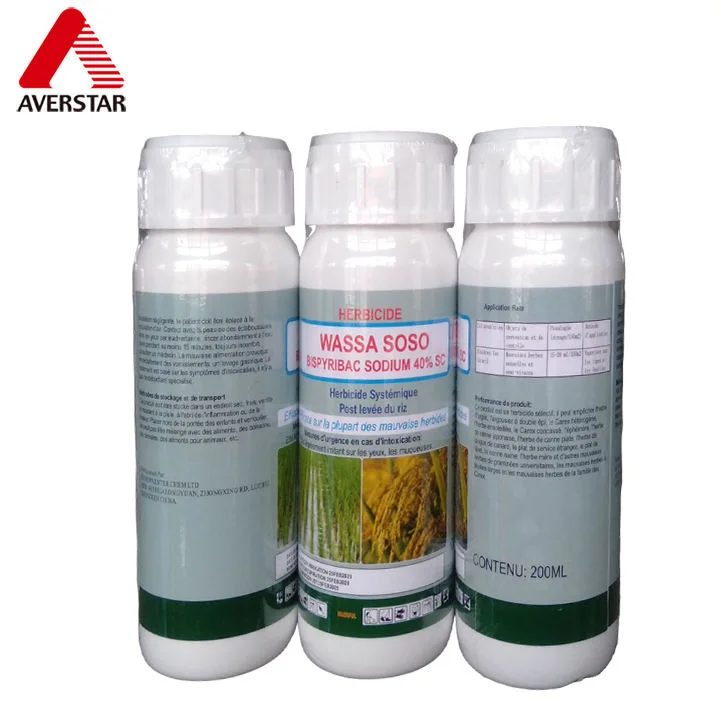
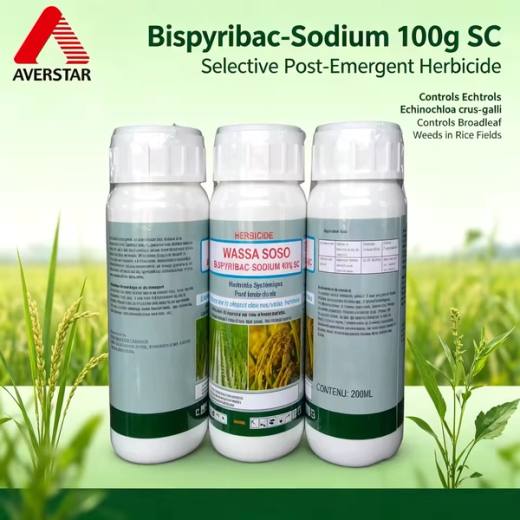
Bispyribac-sodium 100g/L SC is a selective post-emergence herbicide formulation designed primarily for rice production. Its value in modern rice management comes from its systemic activity, relatively broad spectrum across grass, sedge and broadleaf plants, and suitability for post-emergence programs when used according to an approved local label.
For rice growers, distributors and agricultural buyers, however, selecting a product is only one part of the management strategy. Application timing, rice growth stage, target-plant growth stage, water management, spray coverage and resistance management all influence field performance.
This guide explains the technical characteristics of Bispyribac-sodium 100g/L SC, its mode of action, application principles, crop safety considerations, resistance management and its role in modern rice production. The information is based on regulatory documents and published agricultural research rather than unsupported marketing claims.
1. What Is Bispyribac-Sodium 100g/L SC?
Bispyribac-sodium is a selective herbicidal active ingredient belonging to the pyrimidinylbenzoate chemical family. The Herbicide Resistance Action Committee (HRAC) classifies bispyribac-sodium as a Group 2 herbicide, corresponding to inhibition of acetolactate synthase (ALS).
A 100g/L SC formulation means that the product is supplied as a suspension concentrate containing 100 grams of bispyribac-sodium active ingredient per liter of formulated product.
The formulation is particularly relevant to rice production because bispyribac-sodium has been developed and registered in a number of rice production systems for post-emergence management.
For example, a current U.S. EPA registration for an 80% bispyribac-sodium product identifies both dry-seeded and water-seeded rice as use sites and lists several target species, including barnyardgrass, junglerice, knotgrass, arrowhead and other grass, sedge and broadleaf species.
This does not mean that every Bispyribac-sodium 100g/L SC product can automatically be used on every rice variety or against every listed species. Registration is product- and country-specific, so the local label must always take priority.
2. Why Rice Producers Need Effective Post-Emergence Management
Rice production is highly sensitive to competition during early crop development. Grass, sedge and broadleaf plants can compete with rice for light, nutrients, water and growing space.
The challenge is particularly important in direct-seeded rice (DSR) systems. IRRI notes that direct-seeded rice can experience greater competition from unwanted plants than transplanted systems and recommends integrating chemical, mechanical and manual management practices.
Research also demonstrates the potential economic importance of early management.
In a field experiment on direct-planted rice, Jabran and colleagues reported that uncontrolled plant competition reduced rice yield substantially under the experimental conditions, while post-emergence bispyribac-sodium treatment reduced total plant density and dry weight and improved yield-related parameters and economic returns.
More recent research continues to evaluate bispyribac-sodium in direct-seeded rice. A 2024 study conducted in Bihar, India, found that a bispyribac-sodium plus pyrazosulfuron-ethyl program substantially reduced plant density and dry weight compared with an untreated check and produced high grain yields in the experimental conditions.
These studies should not be interpreted as a universal yield guarantee. Field performance depends on soil, climate, rice variety, infestation composition, application timing and many other factors. Their importance is that they demonstrate the role that properly timed post-emergence programs can play in rice production.
3. How Bispyribac-Sodium Works
The most important technical characteristic of Bispyribac-sodium is its ALS-inhibiting mode of action.
ALS, also known as acetohydroxyacid synthase (AHAS), is an enzyme involved in the biosynthesis of the branched-chain amino acids valine, leucine and isoleucine.
Bispyribac-sodium inhibits ALS in susceptible plants. As a result, normal amino-acid biosynthesis is disrupted, plant growth stops and susceptible plants gradually decline.
Scientific literature identifies bispyribac-sodium specifically as an ALS inhibitor and describes its activity against a range of grass, sedge and broadleaf species associated with rice production.
The important practical point is that Bispyribac-sodium is not simply a contact spray that burns plant leaves immediately. Its systemic mode of action means that visible symptoms and complete plant decline can take time.
Therefore, judging performance only by how quickly leaves change color can lead to incorrect conclusions.
4. What Plants Can Bispyribac-Sodium Control?
Bispyribac-sodium has a broad use profile in rice compared with many highly specialized herbicides.
Depending on the registered product and local label, target plants can include:
- Barnyardgrass
- Watergrass
- Junglerice
- Certain sedges
- Arrowhead
- Monochoria
- Eclipta
- Knotgrass
- Selected broadleaf species
The U.S. EPA's product registration database provides a useful regulatory example. Its listed target species include barnyardgrass, baronetgrass, California arrowhead, dayflower, ducksalad, Eclipta, hemp sesbania, junglerice, knotgrass and several other species.
A California EPA label also provides specific growth-stage information for several target species. For example, barnyardgrass is listed from the two-leaf stage through two tillers on that particular label.
This illustrates an important point for professional users:
Target species and growth stage matter as much as the active ingredient itself.
A product that works well on a young barnyardgrass population may not perform the same way against an advanced or resistant population.
5. Bispyribac-Sodium 100g/L SC and Rice Selectivity
One of the reasons bispyribac-sodium is important in rice production is its selectivity.
The active ingredient can inhibit susceptible plants while rice varieties with adequate tolerance can continue growing when the product is applied according to the registered label.
An early FAO AGRIS record describing bispyribac-sodium as a post-emergence rice herbicide reported good compatibility with direct-seeded rice when applied within the specified rice development window in the study.
However, selectivity should never be interpreted as unlimited crop safety.
Scientific research has shown that bispyribac-sodium can inhibit growth of rice seedlings under experimental exposure conditions. A 2022 study in Agronomy reported reductions in plant height and fresh weight of both indica and japonica rice seedlings under experimental bispyribac-sodium exposure.
This reinforces a fundamental rule:
Correct rate + correct timing + correct rice growth stage = better crop safety
Using a higher rate than recommended, spraying an unsuitable rice variety, applying under stressful crop conditions or using an unapproved tank mixture can increase the risk of crop injury.
6. When Should Bispyribac-Sodium 100g/L SC Be Applied?
Application timing is one of the most important factors determining performance.
Bispyribac-sodium is primarily used post-emergence, meaning that the target plants have already emerged when the treatment is made.
The ideal timing depends on:
- Target species
- Target growth stage
- Rice growth stage
- Rice production system
- Local registration
- Weather conditions
- Water management
IRRI recommends selecting herbicides according to the target species and crop or target-plant growth stage, using the recommended rate and ensuring appropriate field conditions.
A U.S. EPA label for bispyribac-sodium provides an example of how specific application timing can be: different target species are associated with different growth-stage windows.
Therefore, there is no responsible universal statement such as “apply at exactly X days after planting” for every rice field.
The correct approach is:
Identify the target → check its growth stage → check the local label → apply within the approved window.
7. Water Management Is an Important Part of Rice Herbicide Performance
Rice is different from many dryland crops because water management can directly affect herbicide performance.
IRRI's Rice Knowledge Bank recommends appropriate field conditions for herbicide activity and emphasizes the importance of following product-specific application instructions. For post-emergence treatments, the field may need to be drained or managed so that the target plant foliage is exposed to the spray.
This is especially important because a foliar-applied post-emergence herbicide needs adequate contact with the target plant.
If the target foliage is completely submerged, spray interception and absorption can be reduced.
Therefore, farmers should consider:
- Field water depth
- Drainage timing
- Re-irrigation timing
- Rainfall forecast
- Spray coverage
- Rice growth stage
Water management should always follow the specific product label, because recommendations can vary between formulations, rice systems and countries.
8. How to Apply Bispyribac-Sodium 100g/L SC More Effectively
Good application is not simply a matter of selecting the right active ingredient.
8.1 Use clean water
IRRI specifically recommends clean water for herbicide spraying because muddy or contaminated water can interfere with spray preparation and performance.
8.2 Calibrate the sprayer
Incorrect calibration can create two problems:
Too little product: insufficient exposure and poor control.
Too much product: increased crop-injury risk and unnecessary environmental loading.
IRRI recommends checking spray equipment and ensuring that nozzles are functioning correctly.
8.3 Maintain uniform spray coverage
A consistent spray pattern is particularly important for post-emergence products.
Check:
- Nozzle condition
- Spray pressure
- Walking or vehicle speed
- Boom height
- Spray volume
- Field overlap
8.4 Avoid unsuitable weather
Strong wind can cause drift and uneven deposition. Heavy rainfall soon after application may also affect performance depending on the formulation and label requirements.
Always follow the registered label for rainfastness and weather restrictions.
9. Bispyribac-Sodium Resistance Management
One of the most important long-term issues surrounding ALS herbicides is resistance.
HRAC classifies bispyribac-sodium as Group 2, an ALS-inhibiting herbicide.
Repeated use of the same mode of action can place selection pressure on plant populations.
Scientific research has documented resistance to bispyribac-sodium in Echinochloa phyllopogon populations in California rice production.
This is not simply a theoretical concern.
Resistance management should therefore be part of the product's application strategy.
Practical resistance-management principles
1. Do not repeatedly rely on the same Group 2 herbicide.
Rotate with herbicides having different modes of action when permitted.
2. Use integrated management.
Chemical treatment can be combined with appropriate water management, crop establishment techniques, mechanical control and other agronomic practices.
3. Control escapes before seed production.
Surviving plants can reproduce and increase the resistant population in future seasons.
4. Avoid unnecessary repeat applications.
Repeated treatment with the same mode of action can increase selection pressure.
5. Use label-approved mixtures or sequences.
Do not assume that any two herbicides are automatically compatible or beneficial when mixed.
The current EPA label for one bispyribac-sodium product specifically provides tank-mix information and warns that unlisted mixtures can cause antagonism or crop-safety problems. It also recommends physical compatibility testing and small-area crop-safety testing for unfamiliar combinations.
10. Is Bispyribac-Sodium Suitable for Direct-Seeded Rice?
Yes, bispyribac-sodium has an important role in direct-seeded rice programs where it is registered.
Direct-seeded rice is increasingly relevant because it can reduce transplanting labor and change the crop establishment process. However, direct seeding can also increase early competition from unwanted plants.
IRRI notes that direct-seeded rice faces greater competition and recommends combining several management approaches rather than depending on a single herbicide.
Published research supports this practical approach.
A 2012 study in Weed Biology and Management evaluated bispyribac-sodium in direct-planted rice and reported strong suppression of total plant density and dry weight under the experimental conditions, along with improvements in several yield-related parameters.
A 2024 study in the same journal evaluated herbicide programs in direct-seeded rice in India's Middle Gangetic Plains and found that a bispyribac-sodium plus pyrazosulfuron-ethyl program performed well under the study conditions.
The lesson is not that one herbicide solves every field problem.
The lesson is that post-emergence herbicide programs can be an important component of integrated direct-seeded rice management when selected and applied correctly.
11. Bispyribac-Sodium 100g/L SC vs. Broad-Spectrum Rice Programs
Bispyribac-sodium has activity across several plant groups, but it should not be described as a universal solution for every rice field.
Rice fields can contain:
- Annual grasses
- Perennial grasses
- Sedges
- Broadleaf plants
- Volunteer rice
- Herbicide-resistant biotypes
No single herbicide can reliably control every species under every condition.
IRRI explicitly recommends choosing products according to the target species and growth stage rather than assuming that one herbicide will solve every problem.
This is particularly important for commercial buyers.
When evaluating a Bispyribac-sodium 100g/L SC product, buyers should consider the intended target spectrum rather than relying only on the phrase “broad-spectrum herbicide.”
A more useful technical question is:
Which target species is the product registered to control in the intended market?
12. How Soil and Water Conditions Can Influence Bispyribac-Sodium
Bispyribac-sodium behavior can be influenced by agricultural management practices.
A 2024 field study examined the medium-term behavior of bispyribac-sodium under different tillage, flooding and irrigation systems. The researchers found that management practices and compost amendment influenced adsorption and potential leaching behavior.
This is particularly relevant in rice because water movement is an integral part of production.
The European regulatory review of bispyribac also highlighted groundwater protection and requested additional information concerning potential groundwater contamination by certain metabolites under vulnerable soil and climatic conditions.
Therefore, responsible use involves more than crop efficacy.
Farmers and distributors should also consider:
- Soil type
- Water movement
- Drainage
- Irrigation practices
- Local environmental restrictions
- Product label requirements
13. Crop Safety: What Farmers Should Check Before Spraying
Before using Bispyribac-sodium 100g/L SC, farmers should verify:
Rice variety
Not every rice variety necessarily has the same tolerance.
Rice growth stage
Use only during the crop stage permitted by the local registration.
Target growth stage
Early treatment may provide better results than allowing target plants to become too mature.
Weather
Avoid unsuitable spraying conditions.
Water level
Follow the label's water-management requirements.
Tank mixtures
Only use tank mixtures that are specifically recommended or permitted.
Sprayer cleanliness
Residual herbicides in the tank can cause unexpected crop injury.
Local registration
The same active ingredient may have different permitted crops, rates and restrictions in different countries.
This last point is critical for exporters.
14. What International Buyers Should Ask for When Purchasing Bispyribac-Sodium 100g/L SC
For importers and distributors, technical quality is only one part of product evaluation.
A professional supplier should be able to discuss:
Active ingredient:
Bispyribac-sodium
Content:
100g/L, subject to the product specification
Formulation:
SC — Suspension Concentrate
Target crop:
Primarily registered rice uses, depending on market authorization
Target plants:
Species listed on the applicable local label
Application stage:
Post-emergence, according to local registration
Technical documents:
- COA
- TDS
- SDS/MSDS
- Product specification
- Formulation information
- Packaging specification
- Shelf-life information
- Batch information
For international trade, buyers should also verify whether the formulation and active ingredient are registered or importable in the destination market.
15. Why the 100g/L SC Formulation Can Be Attractive for Commercial Agriculture
Suspension concentrate formulations are designed to provide a liquid formulation of an active ingredient that is suspended in the formulation system.
For distributors and professional users, an SC product can offer several practical advantages:
- Convenient liquid handling
- Easy measurement
- Compatibility with conventional spray equipment when permitted
- Consistent formulation when manufactured to specification
- Flexible packaging options
- Suitability for commercial agricultural distribution
However, formulation quality matters.
A nominal 100g/L specification alone does not tell the entire story. Commercial buyers should also consider:
- Suspension stability
- Particle size
- Redispersibility
- Storage stability
- Pourability
- pH
- Packaging compatibility
- Batch-to-batch consistency
These characteristics should be verified through the manufacturer's technical specification and quality-control documentation.
16. Bispyribac-Sodium and Sustainable Rice Production
Modern rice production increasingly focuses on productivity while reducing unnecessary inputs.
FAO's latest agricultural statistics release reports that global cereal production increased by 27% between 2010 and 2024, reaching approximately 3.1 billion tonnes, with yield improvement playing an important role.
FAO also reported that global rice production was forecast to reach a record 551.5 million tonnes in 2025, while international rice trade was forecast at 60.5 million tonnes.
These figures show why efficient rice crop management remains commercially important.
However, sustainability does not mean simply applying less pesticide.
A more practical approach is:
Use the right product → at the right stage → at the right rate → with proper water management → while protecting long-term herbicide effectiveness.
Bispyribac-sodium can contribute to that system when it is used as one component of an integrated rice-management program.
17. Bispyribac-Sodium 100g/L SC Application Checklist
Before application:
☑ Confirm the product is registered for rice in the target country.
☑ Identify the dominant target species.
☑ Check the target growth stage.
☑ Check the rice growth stage and variety restrictions.
☑ Read the local product label.
☑ Calibrate the sprayer.
☑ Use clean water.
☑ Confirm field water conditions.
☑ Check weather conditions.
☑ Verify tank-mix compatibility if mixing is permitted.
During application:
☑ Maintain the recommended spray volume.
☑ Maintain uniform application speed.
☑ Ensure appropriate spray coverage.
☑ Avoid unnecessary overlap.
☑ Prevent spray drift to sensitive crops.
After application:
☑ Follow the label's water-management instructions.
☑ Monitor treated areas.
☑ Record the application.
☑ Identify surviving target plants.
☑ Avoid repeated Group 2 applications where resistance is suspected.
18. Frequently Asked Questions
How is Bispyribac-sodium 100g/L SC used?
It is primarily used as a selective post-emergence herbicide in registered rice crops. The correct application rate, timing, water management and target species must follow the local product label.
How does Bispyribac-sodium work?
It inhibits ALS, an enzyme involved in the biosynthesis of branched-chain amino acids. This disrupts growth in susceptible plants. HRAC classifies it as Group 2.
How can farmers improve application results?
Use the recommended rate, apply at the appropriate growth stage, maintain suitable field conditions and ensure uniform spray coverage. IRRI also recommends clean water and properly calibrated equipment.
How can resistance be managed?
Avoid repeated reliance on Group 2 herbicides. Rotate or use approved programs involving different modes of action and integrate chemical treatment with water, mechanical and cultural management.
How should buyers evaluate a 100g/L SC product?
Check active ingredient content, formulation quality, COA, TDS, SDS/MSDS, registration status, packaging, shelf life and target-market requirements before purchasing.
19. Conclusion
Bispyribac-sodium 100g/L SC is a technically important post-emergence rice herbicide based on an ALS-inhibiting active ingredient. Its value comes from its activity against several grass, sedge and broadleaf species and its established role in rice production systems.
Scientific research and regulatory documentation demonstrate that bispyribac-sodium can provide effective post-emergence management under appropriate conditions. At the same time, research and regulatory sources also show why application timing, crop safety, water management and resistance management cannot be ignored.
For farmers, the key is not simply choosing a high-quality herbicide. The key is using it at the correct crop stage, against the correct target, at the approved rate and as part of an integrated management program.
For international buyers, a reliable Bispyribac-sodium 100g/L SC supplier should provide more than a product name and price. Technical documentation, formulation consistency, registration support, packaging flexibility and market-specific compliance are equally important.
Ultimately, the best rice herbicide program is one that combines effective crop protection, responsible application and long-term resistance management.
Authoritative References and Further Reading
- U.S. Environmental Protection Agency — Bispyribac-sodium Chemical Information
US EPA Bispyribac-sodium Chemical Details - U.S. EPA — AX Bispyribac-Sodium Registration Information
US EPA Product Registration and Use Information - Herbicide Resistance Action Committee — Global Classification Lookup
HRAC Global Herbicide Classification Lookup - IRRI Rice Knowledge Bank — Herbicides and Application Guidance
IRRI Rice Knowledge Bank Herbicide Guidance - IRRI Rice Knowledge Bank — Rice Weed Management
IRRI Rice Knowledge Bank Weed Management - FAO — FAOSTAT Agricultural Production Statistics
FAOSTAT Agricultural Production Data - Jabran et al. — Weed Control in Direct-Planted Rice, Weed Biology and Management
Published Research on Bispyribac-Sodium in Direct-Planted Rice
Buyer decision guide
Product positioning and benefits
A professional Bispyribac-sodium 100g/L SC supply option for buyers evaluating international distribution, registration-support or private-label projects.
- Clearly identified active ingredient, concentration and SC formulation
- Specification and quality-document review available during quotation
- Packaging, labeling and export requirements can be assessed for the destination market
- Suitable for sample, trial-order and repeat-distribution enquiries, subject to confirmation
Mode of action
Product Performance: This product is a selective herbicide that inhibits acetolactate synthesis—thereby blocking the biosynthesis of branched-chain amino acids—following absorption through roots and leaves. It is suitable for use in direct-seeded rice fields, offers a wide application window, and controls a broad spectrum of weeds, including grasses (e.g., barnyard grass, *Paspalum distichum*), broad-leaved weeds (e.g., *Monochoria vaginalis*, *Lindernia procumbens*, *Rotala indica*, *Sagittaria pygmaea*, *Lindernia antipoda*), and sedges (e.g., *Cyperus difformis*, *Fimbristylis miliacea*, *Cyperus iria*, *Scirpus juncoides*, *Scirpus nipponicus*, *Scirpus planiculmis*). Precautions: 1. Maximum of one application per crop season. 2. In *japonica* rice, leaf yellowing may occur after treatment but typically resolves within 4–5 days without affecting yield. 3. Do not till the soil after application to avoid disrupting the herbicide layer and compromising efficacy. 4. Wear long-sleeved clothing, long trousers, gloves, and a mask during application; do not eat, drink, or smoke while applying. Wash hands and face thoroughly after application. 5. This product is toxic to bees, aquatic organisms (such as fish), and silkworms. Avoid affecting nearby bee colonies during application; do not use near flowering plants during their bloom period, silkworm rearing rooms, or mulberry orchards. Apply away from aquaculture zones and bodies of water (rivers, ponds); do not wash application equipment in such waters. Do not use in areas where natural enemies like *Trichogramma* wasps are released. Do not use in rice fields co-cultured with fish, shrimp, or crabs; do not discharge runoff water into bodies of water after application. 6. This product is toxic to fish; wastewater from cleaning equipment must not be discharged into rivers, ponds, or other water sources. Dispose of used containers properly; do not reuse or discard them indiscriminately. 7. Avoid exposure for pregnant or lactating women. First Aid for Poisoning: Mildly irritating to skin and eyes. If inhaled, move the patient to an area with fresh air. If splashed into eyes, rinse with plenty of water for at least 15 minutes; seek medical attention if discomfort persists. In case of skin contact, wash thoroughly with soap and water. If swallowed, take the patient to the hospital immediately, bringing the product label along. No specific antidote exists. Treat symptomatically. Storage and transportation: Store in a cool, dry, well-ventilated area protected from rain. Keep away from sources of fire or heat. Store under lock and key, out of the reach of children and unauthorized persons. Do not store or transport together with food, beverages, animal feed, grain, or other similar commodities.
Practical product guide
Applications, formulation and supply
A procurement-focused overview of where this product is typically considered, how it is supplied, and which commercial details should be confirmed before ordering.
Applications / crops
Where buyers commonly evaluate this product.
- Field crops and broad-acre weed-management programs (confirm the approved local label).
Target pests / diseases
Target scope for product selection; verify the local label.
- Annual grasses and broadleaf weeds; target spectrum must be confirmed on the destination-market label.
Formulation options
Available formulation formats for quotation.
- Bispyribac-sodium 100g/L SC
Packaging options
Product video
imdia 40 sc
Bispyribac-Sodium 100g/L SC is a selective post-emergence rice herbicide for grass, sedge, and broadleaf plant control. Learn about its use, mode of action, and application.
Technical data
Specifications
- Active ingredient
- Bispyribac-sodium
- Content
- 100g/L
- Formulation
- SC
- CAS number
- 125401-92-5
- Molecular formula
- C19H17N4NaO8