
Averstar Chemical Editorial Team Updated November 4, 2026
Bispyribac-Sodium Rice Herbicide: Formulation Buyer Guide
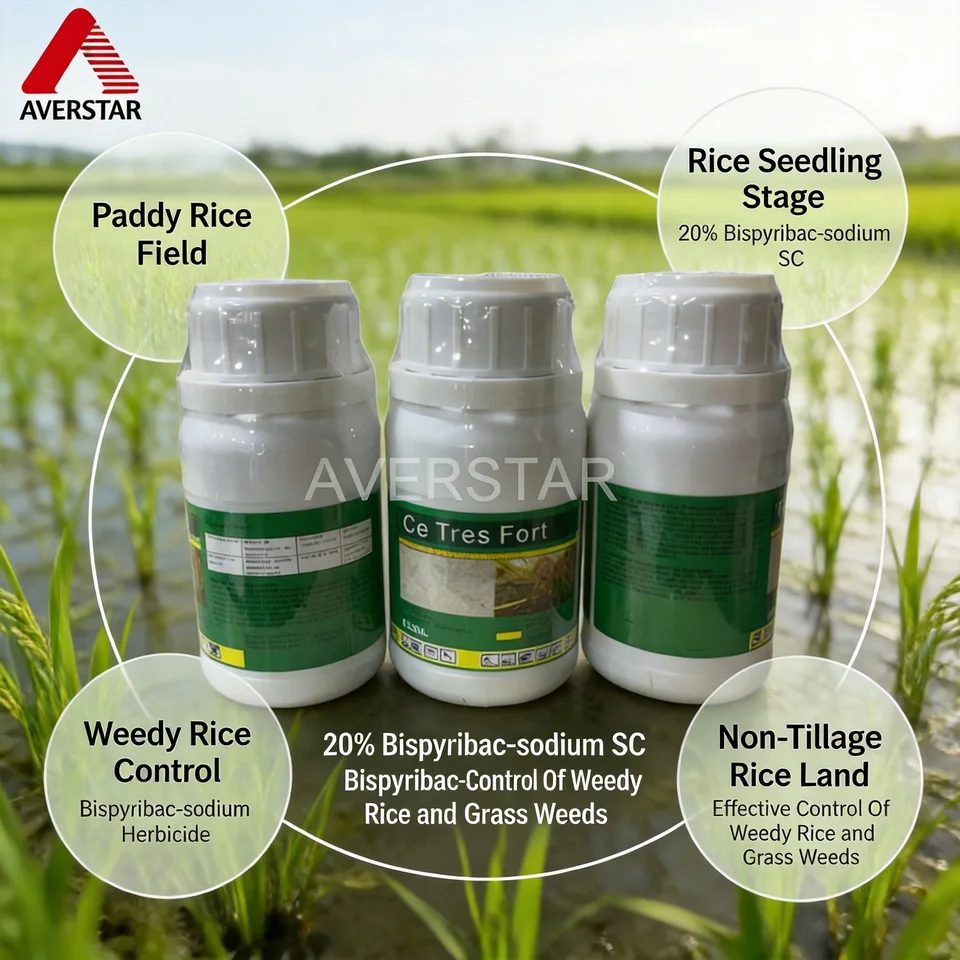
Bispyribac-sodium is a post-emergence rice herbicide, and buyers usually meet it as a suspension concentrate at several strengths or in ready mixtures with a grass herbicide or a sulfonylurea. The useful selection questions come from the field: which weeds are present, how large they are at application, how the paddy water is managed and whether the label covers direct-seeded or transplanted rice.
Averstar's catalogue lists bispyribac-sodium at 100 g/L, 20% and 40% SC, two mixtures with cyhalofop-butyl and one with bensulfuron-methyl. This guide explains how to compare those options, what each partner adds and which documents to request. The approved destination-market label always decides the permitted crop situations, dose, timing and restrictions for the product actually supplied.
Quick answer: Match the product to the rice system and the main weeds, then compare concentration and documents. Choose a mixture for what the partner adds: cyhalofop-butyl adds a second mode of action against grasses, while bensulfuron-methyl widens the weed spectrum within the same mode of action.
What bispyribac-sodium does
The University of Hertfordshire Pesticide Properties Database (PPDB) entry for bispyribac-sodium describes a post-emergence herbicide for grasses, sedges and broadleaf weeds in paddy rice. It is selective and systemic, absorbed by foliage and roots, and inhibits acetohydroxyacid synthase (AHAS, also called ALS). In the HRAC global herbicide classification, ALS inhibitors form Group 2, a group with many reported resistant weed populations. In areas where rice weeds have already survived repeated ALS-inhibitor use, ask the local adviser which species escaped before relying on a Group 2 product.
Weeds compete with rice most strongly early in the season, which is why post-emergence timing matters. The IRRI Rice Knowledge Bank weed management pages explain how weed pressure and control options differ between rice establishment methods.
Weed stage and water management come first
Post-emergence herbicides generally work best on small, actively growing weeds, and rice labels usually tie the application to a weed leaf stage. Many labels also specify how field water should be managed before and after spraying, because draining, holding or re-flooding the paddy changes how much of the weed is exposed and how the product behaves. UC IPM's rice weed management guidelines show how identification, timing and water management fit together in a weed programme.
Before comparing products, record the rice establishment method (direct-seeded or transplanted), the dominant weed species and their typical size at the planned timing, and how the grower can manage water around the application.
Compare the single-active SC products
- Bispyribac-sodium 100 g/L SC, 20% SC and 40% SC: suspension concentrates, which the PPDB notes is the usual format. Each concentration is a separately registered product, so the quotation, certificate of analysis and label must all name the same one. A stronger product needs less formulated material per hectare; it does not control more weeds.
Watch the concentration unit: 100 g/L is grams per litre of product, while a percentage may be weight-for-weight or weight-for-volume. A 20% product expressed by weight is not the same as 200 g/L unless the density is 1. For any SC, ask for suspensibility and storage-stability results, and confirm the product re-suspends easily after storage, as covered in FAO/WHO pesticide specifications.
What the mixture partners add
- Cyhalofop-butyl + bispyribac-sodium 150 g/L / 50 g/L OD and 15% / 5% OD: the PPDB describes cyhalofop-butyl as a post-emergence grass herbicide used mainly in rice, including against barnyardgrass, which inhibits ACCase (HRAC Group 1) and has no soil activity. The mixture therefore combines two modes of action against grass weeds. Our cyhalofop-butyl formulation guide covers the grass-herbicide side in more detail. OD means oil dispersion: ask how dispersion stability is tested and how the product should be re-mixed before use.
- Bispyribac-sodium + bensulfuron-methyl 180 g/kg / 120 g/kg WP: the PPDB describes bensulfuron-methyl as a sulfonylurea for annual and perennial weeds and sedges that also inhibits AHAS. Both partners are Group 2, so the mixture widens the weed spectrum, particularly against sedges and broadleaf weeds, without adding a second mode of action. As a wettable powder, it is checked for suspensibility and wettability and needs dust-tight packaging.
A ready mixture is legal only where that exact mixture is registered; two single-active registrations do not authorise a combined product. For other rice programmes, our propanil rice herbicide guide covers a different mode of action.
A product selection checklist
- Rice establishment method and crop stage on the destination-market label.
- Dominant weeds by species, their size at the planned timing, and any escapes after ALS-inhibitor use.
- Water management the grower can follow before and after application.
- Single active or mixture, and whether the partner adds a second HRAC group.
- Concentration and unit matched on quotation, certificate of analysis and label.
- Formulation tests: suspensibility and storage stability for SC, dispersion stability for OD, wettability for WP.
- Packaging, safety data sheet and label artwork in the destination language.
Build the inquiry around the intended use
Send the rice system, the target weeds, the preferred product and concentration, the packaging and the destination market through our contact form. For a first order, a pesticide sample evaluation plan helps compare samples against the agreed specification before scaling up.
Frequently asked questions
Is bispyribac-sodium 40% SC better than 20% SC?
Not by itself. The concentration changes how much product is needed per hectare and the freight and packaging cost, not the weeds controlled. Compare the options on registration status, label rate, formulation quality and price per treated hectare.
Does bispyribac-sodium control weedy rice?
Do not assume so. Weedy rice is the same species as cultivated rice, so a selective rice herbicide cannot be expected to remove it unless the label in your market specifically includes it. Treat weedy rice as a separate management question with the local adviser.
Does bispyribac + bensulfuron-methyl give two modes of action?
No. Both actives inhibit AHAS and belong to HRAC Group 2. The mixture broadens the weed spectrum, but for resistance management it counts as one mode of action. The cyhalofop-butyl mixtures are the options that add a second group.
Authoritative references
- PPDB: Bispyribac-sodium - University of Hertfordshire PPDB
- Global Herbicide Classification Lookup - Herbicide Resistance Action Committee
- Weeds – IRRI Rice Knowledge Bank - IRRI Rice Knowledge Bank
- Rice: Weed Management Guidelines - UC Statewide IPM Program
- Pesticide Specifications and Quality Control (FAO/WHO JMPS) - FAO
- PPDB: Cyhalofop-butyl - University of Hertfordshire PPDB
- PPDB: Bensulfuron-methyl - University of Hertfordshire PPDB