
Averstar Chemical Editorial Team Updated November 7, 2026
Deltamethrin, Fenpropathrin and Etofenprox: Pyrethroid Buyer Guide
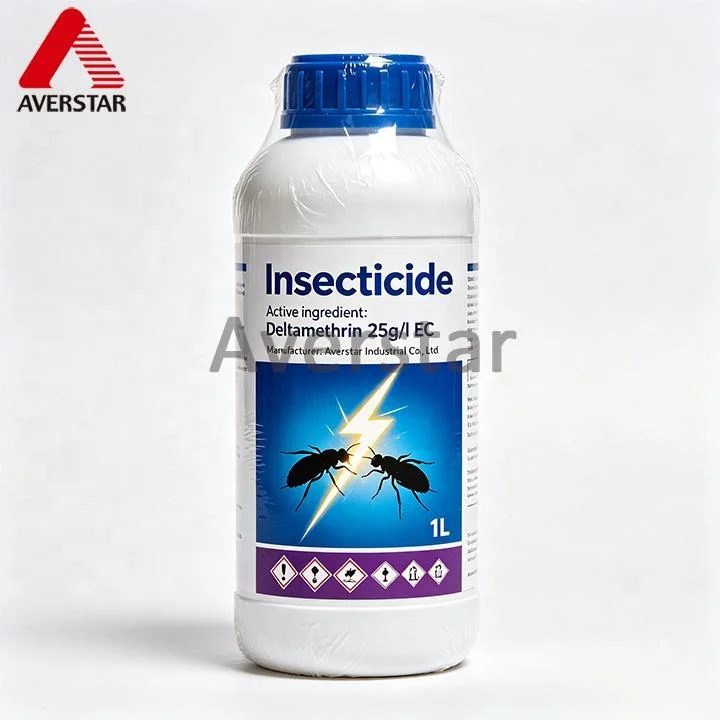
Pyrethroids are fast-acting contact insecticides used on field crops, in stored products and in public health, and buyers usually compare several of them at once. Deltamethrin, fenpropathrin and etofenprox all belong to the same mode of action group, but they differ in the pests and situations they are registered for. Choosing between them starts with the registered use and the pest, then the rotation programme.
Averstar's catalogue lists deltamethrin as two EC products and a 5 g/kg product, fenpropathrin 20% EC and etofenprox 10% and 30% SC. Our cypermethrin and lambda-cyhalothrin guides cover two more pyrethroids. The approved destination-market label always decides the crops, pests, situations, dose and restrictions for the product actually supplied.
Quick answer: Match the active to the registered use: deltamethrin for a wide range of crop, storage and public-health pests; fenpropathrin where mites and insects need control together; etofenprox for labelled uses such as paddy rice, fruit and vegetables. All are IRAC Group 3A, so rotate with other groups and observe water and bee restrictions.
What pyrethroids do
Pyrethroids keep the sodium channels of insect nerves open, so the nerves fire continuously and the insect is quickly knocked down. The IRAC mode of action classification places them in Group 3A. They are non-systemic and act by contact and ingestion, so they protect only the surfaces the spray reaches and do not move into new growth.
How the three actives differ
University of Hertfordshire Pesticide Properties Database (PPDB) records describe the actives as follows:
- Deltamethrin: a fast-acting insecticide against a wide range of sucking and chewing pests, from aphids and beetles in crops to cockroaches, ants and fleas in public-health settings. Crop, stored-product and public-health uses are registered separately.
- Fenpropathrin: an acaricide and insecticide used against mites, whiteflies, leafminers, armyworms and loopers. Its activity on mites sets it apart from most pyrethroids, but mite programmes still need rotation with dedicated acaricide groups, as explained in our acaricide guide.
- Etofenprox: a broad-spectrum insecticide used against aphids, moths, leafminers and other pests on fruit, vegetables and in paddy fields. Chemically it is an ether rather than an ester like most pyrethroids, but it acts on the same target and shares Group 3A.
Rotation, water and pollinators
Pyrethroid resistance has been reported in many pests, and resistance to one pyrethroid can extend to others. Switching between deltamethrin, fenpropathrin, etofenprox, cypermethrin or lambda-cyhalothrin is therefore not a rotation; alternate with insecticides from other IRAC groups registered for the same pest.
Pyrethroids are generally highly toxic to fish and aquatic invertebrates, and many are toxic to bees. Labels therefore commonly include buffer zones near water and restrictions on spraying flowering crops when bees are active. Include these warnings in distributor training and in the translated label artwork.
Compare the catalogue formulations
- Deltamethrin: the higher-strength EC, the 5% EC and the 5 g/kg product, which its product page presents for stored-grain protection. Confirm the registered concentration, unit and use for each before quoting; a stored-grain product carries its own label and residue requirements.
- Fenpropathrin 20% EC: an emulsifiable concentrate, a solvent-based liquid that forms an emulsion in water.
- Etofenprox 10% / 30% SC: suspension concentrates offered at two strengths; each is a separate registered product.
Penn State Extension's overview of pesticide formulations compares EC, SC and solid formulations, and FAO/WHO pesticide specifications describe the properties buyers test, such as emulsion stability and suspensibility.
A product selection checklist
- The registered use in the destination market: crop, stored product or public health.
- Target pests by species, including mites where fenpropathrin is considered.
- The IRAC groups already used against the pest, so Group 3A fits a rotation.
- Water buffer zones and pollinator restrictions on the label.
- Concentration and unit matched on quotation, certificate of analysis and label.
- Formulation tests suited to EC, SC or solid products.
- Solvent-compatible packaging for EC products, safety data sheet and translated label.
Build the inquiry around the intended use
Send the registered use, the target pests, the preferred active and concentration, the packaging and the destination market through our contact form. For a first order, a pesticide sample evaluation plan helps compare samples against the agreed specification before scaling up.
Frequently asked questions
Can deltamethrin and lambda-cyhalothrin be rotated?
Not for resistance management. Both are pyrethroids in IRAC Group 3A, like cypermethrin, fenpropathrin and etofenprox. Rotate with an insecticide from another group registered for the same pest.
Can fenpropathrin replace a dedicated acaricide?
Only where its label lists the mite. Fenpropathrin has mite activity, but mites develop resistance quickly, so it belongs in a rotation with acaricides from other groups rather than replacing them.
Is a stored-grain deltamethrin product the same as a crop spray?
No. Stored-grain and crop products have separate registrations, rates and residue limits. Use each only for the purpose on its label.
Authoritative references
- IRAC Mode of Action Classification - Insecticide Resistance Action Committee
- PPDB: Deltamethrin - University of Hertfordshire PPDB
- PPDB: Fenpropathrin - University of Hertfordshire PPDB
- PPDB: Etofenprox - University of Hertfordshire PPDB
- Pesticide Formulations - Penn State Extension
- Pesticide Specifications and Quality Control (FAO/WHO JMPS) - FAO