
Averstar Chemical Editorial Team Updated November 4, 2026
Cypermethrin vs Alpha-Cypermethrin: Formulation Buyer Guide
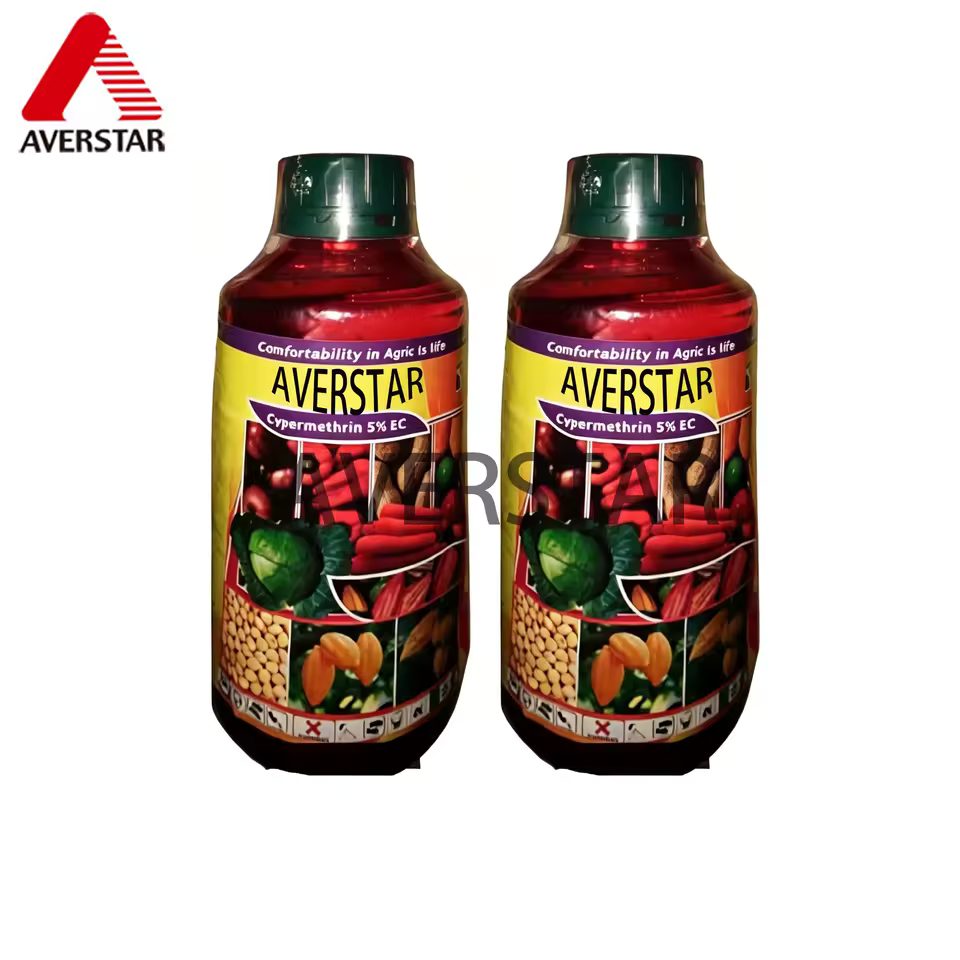
Cypermethrin is one of the most widely traded pyrethroid insecticides, and buyers often meet it in several forms in a single price list: cypermethrin EC, alpha-cypermethrin SC, and ready mixtures with profenofos or imidacloprid. These products are related, but they are not interchangeable. The active ingredient, its isomer composition, the formulation type and the approved label each change what the product is and how it may be used.
Averstar's catalogue lists cypermethrin 4.5% EC and 5% EC, alpha-cypermethrin 5% SC and 100 g/L SC, and three cypermethrin mixtures. This guide explains how to read those descriptions, what each mixture partner adds, and which documents to request. The approved destination-market label always decides the crops, pests, dose, timing and restrictions for the product actually supplied.
Quick answer: First confirm whether the product registered in your market is cypermethrin, alpha-cypermethrin or a specific mixture, then compare formulation type, concentration and documents. Never convert a dose between cypermethrin and alpha-cypermethrin, or between an EC and an SC, by arithmetic alone.
What cypermethrin does
The University of Hertfordshire Pesticide Properties Database (PPDB) entry for cypermethrin describes a non-systemic insecticide with contact and stomach action that works as a sodium channel modulator, used against a broad spectrum of pests and especially caterpillars. In the IRAC mode of action classification, cypermethrin and alpha-cypermethrin belong to Group 3A, the pyrethroids and pyrethrins.
Two practical points follow from that profile. Because the product is non-systemic, it does not move through the plant to protect new growth; performance depends on the spray reaching the pest or the surface it feeds on. And because Group 3A is used so widely, pyrethroid resistance has been reported in a number of important pests. Local programmes therefore usually rotate Group 3A with other IRAC groups rather than repeating pyrethroid sprays. Ask which groups are already used in the target crop before choosing a pyrethroid or a pyrethroid mixture.
Cypermethrin and alpha-cypermethrin are different actives
Technical cypermethrin is a mixture of several stereoisomers. Alpha-cypermethrin is an isomer-enriched product with its own specifications, registrations and label rates, and the PPDB keeps alpha-cypermethrin as a separate active substance. Beta-cypermethrin and zeta-cypermethrin are further isomer products with separate registrations. Treat each name as its own active ingredient:
- A registration for cypermethrin does not authorise alpha-cypermethrin, and the reverse is also true.
- Alpha-cypermethrin is typically used at lower active-ingredient rates per hectare than cypermethrin, so comparing "5% against 5%" across the two actives says little about how much product a field needs.
- The certificate of analysis should name the exact active and its content. For isomer-enriched products, ask how the isomer composition is specified and tested.
When a tender asks for "cypermethrin", confirm whether the buyer means the generic active or one of the isomer products before quoting.
Compare the catalogue formulations
- Cypermethrin 4.5% EC and Cypermethrin 5% EC: emulsifiable concentrates, the format PPDB notes cypermethrin is most often supplied in. The active is dissolved in solvent with emulsifiers and forms an emulsion when mixed with water. Penn State Extension's overview of pesticide formulations explains the handling differences between EC and other formulation types. The two concentrations are different registered products, so the quotation, certificate and label should all name the same one.
- Alpha-cypermethrin 5% SC and Alpha-cypermethrin 100 g/L SC: suspension concentrates, in which fine solid particles of the active are dispersed in a water-based liquid. SC products need agitation before use and are checked for suspensibility rather than emulsion stability.
Watch the concentration unit. A percentage may be weight-for-weight or weight-for-volume, while g/L is always grams per litre of product. A 5% product expressed by weight is not the same as 50 g/L unless the formulation density happens to be 1. State the unit the registration uses on every document.
What the mixture partners add
- Profenofos + cypermethrin 40% + 4% EC and 400 g/L + 40 g/L EC: the PPDB describes profenofos as a non-systemic acetylcholinesterase inhibitor used mainly against caterpillars and mites; IRAC places organophosphates in Group 1B. The mixture therefore combines two modes of action. The registration status of organophosphates differs widely between countries, so confirm the mixture is approved in the destination market before preparing samples.
- Imidacloprid + cypermethrin 150 g/L + 50 g/L SC: the PPDB lists imidacloprid as a systemic insecticide acting on the nicotinic acetylcholine receptor (IRAC Group 4A), used mainly against sucking and soil insects. The combination pairs systemic uptake with the contact action of cypermethrin. Neonicotinoid use is restricted in some markets, especially around flowering crops; our imidacloprid formulation guide covers those questions in more detail.
A ready mixture is legal only where that exact mixture is registered. Two single-active registrations do not authorise a combined product.
Plan for water and pollinator restrictions
Cypermethrin is very highly toxic to fish and aquatic invertebrates: the PPDB entry lists an acute 96-hour LC50 for fish of about 0.0015 mg/L, and the National Pesticide Information Center cypermethrin fact sheet describes cypermethrin as highly toxic to fish, aquatic insects and bees. Labels therefore commonly include buffer zones near water and restrictions on spraying flowering crops when bees are foraging. Plan distributor training and translated label artwork for these warnings before the first shipment, and keep the safety data sheet aligned with the destination-market label.
A product selection checklist
- The registered active in your market: cypermethrin, alpha-cypermethrin or a named mixture.
- Formulation type (EC or SC) and concentration exactly as registered.
- The concentration unit (% w/w, % w/v or g/L) matched on the quotation, certificate of analysis and label.
- The IRAC groups already used in the target crop programme, so the pyrethroid fits a rotation.
- Label restrictions for water bodies, bees and pre-harvest intervals in the destination market.
- Quality documents: certificate of analysis, safety data sheet, label draft, and the formulation properties the importer tests against FAO/WHO pesticide specifications.
- Packaging material compatible with the formulation, especially solvent-based EC products.
Build the inquiry around the intended use
Send the registered active and formulation, the concentration and unit, the crop and target pests, the packaging and the destination market through our contact form. For a first order, a pesticide sample evaluation plan helps compare samples against the agreed specification before scaling up. If you are also comparing other pyrethroids, see our lambda-cyhalothrin formulation guide.
Frequently asked questions
Can alpha-cypermethrin replace cypermethrin at the same dose?
No. They are different active substances with separate registrations and labels, and alpha-cypermethrin is normally used at lower active-ingredient rates. Use only the rate on the label of the product actually registered in your market.
Is 5% EC better than 4.5% EC?
Not by itself. Concentration changes how much formulated product is needed per hectare, not which pests the active controls. Compare the two on registration status, label rate per hectare, formulation quality and packaging cost.
Does a cypermethrin mixture reduce resistance risk?
Only partly. A mixture with a different IRAC group, such as profenofos or imidacloprid, adds a second mode of action, but it still contains a Group 3A pyrethroid. Fit the mixture into a rotation with other groups instead of using it in every spray.
Authoritative references
- PPDB: Cypermethrin - University of Hertfordshire PPDB
- IRAC Mode of Action Classification - Insecticide Resistance Action Committee
- PPDB: Alpha-cypermethrin - University of Hertfordshire PPDB
- Pesticide Formulations - Penn State Extension
- PPDB: Profenofos - University of Hertfordshire PPDB
- PPDB: Imidacloprid - University of Hertfordshire PPDB
- Cypermethrin General Fact Sheet - National Pesticide Information Center
- Pesticide Specifications and Quality Control (FAO/WHO JMPS) - FAO