
Averstar Chemical Editorial Team Updated November 7, 2026
Acaricide Buyer Guide: Bifenazate, Hexythiazox, Fenpyroximate and More
Spider mites and other plant-feeding mites can build up very quickly in warm, dry conditions, and they develop resistance faster than most insect pests. Choosing an acaricide is therefore less about finding the strongest product and more about matching the product to the mite life stage and rotating modes of action across the season.
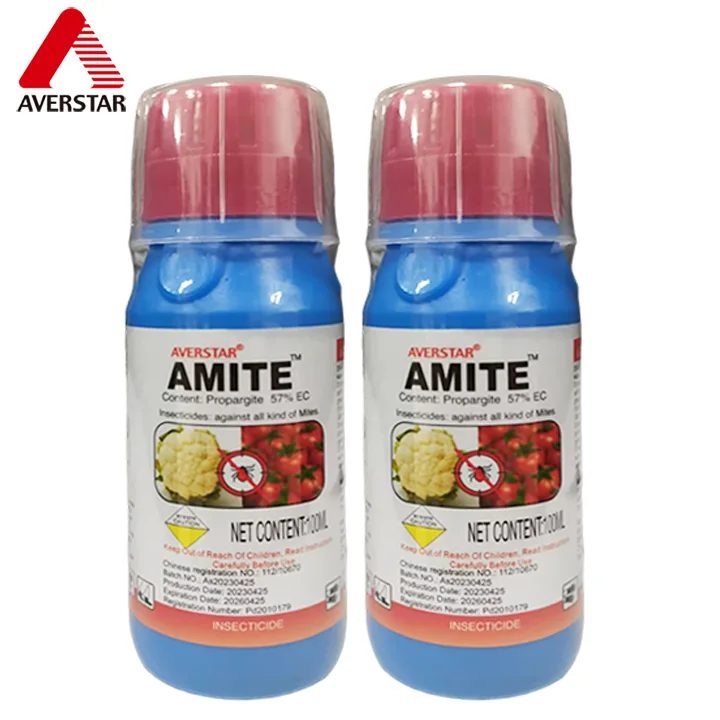
Averstar's catalogue lists bifenazate 43% SC, hexythiazox 5% and 10% WP, fenpyroximate 5% and 20% SC, propargite 57% EC, fenbutatin oxide 20% SC and amitraz 20% EC. This guide explains what each active does, how they group for resistance management and which documents to request. The approved destination-market label always decides the crops, pests, dose, timing and restrictions for the product actually supplied.
Quick answer: Use the life stage to choose: hexythiazox works on eggs and young mites, while the other actives also act on moving stages. Rotate between IRAC groups, remembering that propargite and fenbutatin oxide share Group 12, and confirm registration status, because several older acaricides are restricted in some markets.
Why mite control depends on rotation
Mites complete a generation in days in hot weather and lay large numbers of eggs, so a product used repeatedly can select a resistant population within a season. The IRAC mode of action classification groups acaricides by their target site; rotating between groups, rather than between brand names, is the basis of resistance management. Many programmes limit each group to one application per season, and the label may set its own limit.
Mite products also differ in how they affect predatory mites and other natural enemies. Where growers rely on predatory mites, ask the local adviser which products fit that programme.
What each acaricide does
University of Hertfordshire Pesticide Properties Database (PPDB) records describe the six actives as follows:
- Bifenazate: a non-systemic acaricide with contact and residual action against spider mites and other plant-feeding mites, acting on mitochondrial complex III (IRAC Group 20D).
- Hexythiazox: a mite growth inhibitor (IRAC Group 10A) used against the eggs and larvae of many mites. It does not kill adult mites, so it works best early, before a population builds up.
- Fenpyroximate: a contact acaricide acting on mitochondrial complex I (IRAC Group 21A), used against several families of plant-feeding mites in fruit and other crops.
- Propargite and fenbutatin oxide: non-systemic contact acaricides that inhibit mitochondrial ATP synthase. They sit in IRAC Group 12 (subgroups 12C and 12B), so rotate to another group rather than between them.
- Amitraz: an amidine acaricide and insecticide with contact and respiratory action, an octopamine receptor agonist (IRAC Group 19). It also has veterinary uses, which are registered separately from plant-protection products.
Registration status of several older acaricides, including organotin and some amidine products, is restricted in some markets. Confirm the status of each active in the destination market before preparing samples.
Compare the catalogue formulations
- Bifenazate 43% SC, Fenpyroximate 5% / 20% SC and Fenbutatin oxide 20% SC: suspension concentrates, water-based liquids that need agitation before use and are tested for suspensibility.
- Hexythiazox 5% / 10% WP: a wettable powder offered at two concentrations; each is a separate registered product, so the quotation, certificate and label must name the same one.
- Propargite 57% EC and Amitraz 20% EC: emulsifiable concentrates, solvent-based liquids that need packaging suited to solvents.
Penn State Extension's overview of pesticide formulations compares these formulation types. For quality checks, ask for the certificate of analysis together with suspensibility, wettability or emulsion stability results, as described in FAO/WHO pesticide specifications.
A product selection checklist
- The mite species and the life stages present at the planned timing.
- The IRAC groups already used against mites this season.
- Whether the programme relies on predatory mites or other natural enemies.
- Registration status of the active in the destination market.
- Concentration and unit matched on quotation, certificate of analysis and label.
- Formulation tests: suspensibility for SC, wettability for WP, emulsion stability for EC.
- Packaging, safety data sheet and translated label artwork.
Build the inquiry around the intended use
Send the crop, the mite species, the groups already used, the preferred active and concentration, the packaging and the destination market through our contact form. For other insect-control products, see our cypermethrin guide, and use a pesticide sample evaluation plan to compare samples before scaling up.
Frequently asked questions
Why did hexythiazox not kill the adult mites?
Hexythiazox acts on eggs and young mites, not adults. It is used early, before the population builds, or alongside a product from another group that acts on moving stages, as the label allows.
Can propargite and fenbutatin oxide be rotated with each other?
Not for resistance management. Both inhibit mitochondrial ATP synthase and sit in IRAC Group 12, so rotate to a product from another group.
Is amitraz for crops the same as amitraz for livestock?
No. Plant-protection and veterinary amitraz products are registered separately, with different labels and uses. Use only the product registered for the intended purpose.
Authoritative references
- IRAC Mode of Action Classification - Insecticide Resistance Action Committee
- PPDB: Bifenazate - University of Hertfordshire PPDB
- PPDB: Hexythiazox - University of Hertfordshire PPDB
- PPDB: Fenpyroximate - University of Hertfordshire PPDB
- PPDB: Propargite - University of Hertfordshire PPDB
- PPDB: Fenbutatin oxide - University of Hertfordshire PPDB
- PPDB: Amitraz - University of Hertfordshire PPDB
- Pesticide Formulations - Penn State Extension
- Pesticide Specifications and Quality Control (FAO/WHO JMPS) - FAO