
Averstar Chemical Editorial Team Updated November 7, 2026
Cartap, Thiocyclam, Carbaryl and Bendiocarb: Nereistoxin and Carbamate Insecticide Guide
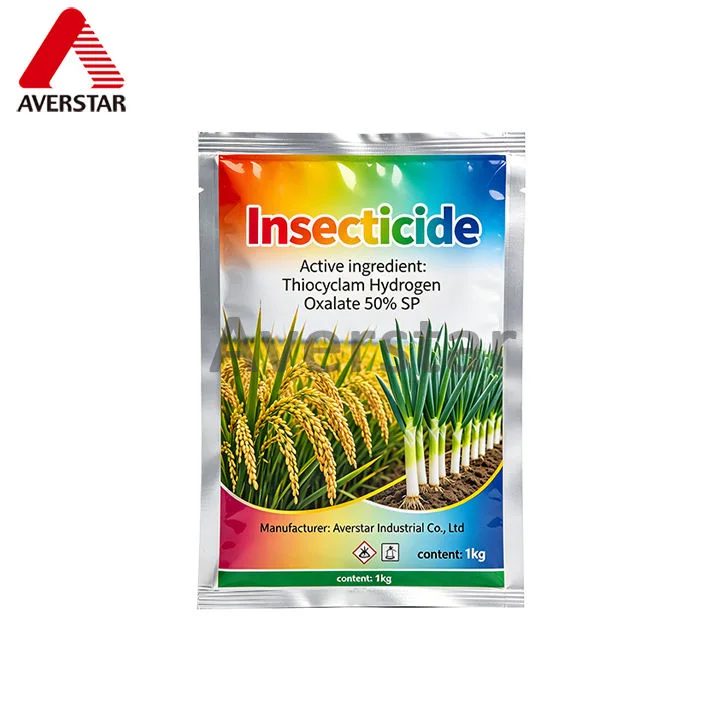
Cartap, thiocyclam, carbaryl and bendiocarb are established insecticides that remain in demand in many markets. They belong to two different groups. Cartap and thiocyclam are nereistoxin analogues, modelled on a natural toxin from a marine worm, which block insect nicotinic receptor channels. Carbaryl and bendiocarb are carbamates, which inhibit acetylcholinesterase in the same way as organophosphates. Knowing the group decides how each fits a rotation.
Averstar's catalogue lists cartap hydrochloride 50% SP, thiocyclam hydrogen oxalate 50% SP, carbaryl 25% and 85% WP, and bendiocarb 80% WP for public health. This guide explains how the actives are used and which documents to request. The approved destination-market label always decides the crops, pests, situations, dose and restrictions for the product actually supplied.
Quick answer: Use cartap or thiocyclam where their labels list the target pests, and treat them as one IRAC group (14). Use carbaryl for the crop pests or fruit thinning its label covers, and bendiocarb only for public-health uses. Carbamates (1A) and organophosphates (1B) share a target, so they do not rotate with each other.
Cartap and thiocyclam
The IRAC mode of action classification places nereistoxin analogues in Group 14, nicotinic acetylcholine receptor channel blockers. University of Hertfordshire Pesticide Properties Database (PPDB) records describe them as follows:
- Cartap: an insecticide against chewing and sucking pests, with example pests including aphids, thrips, whiteflies, jassids and spider mites, and example crops including soya beans, peanuts, maize, wheat, fruit, vines, tea, cotton and sugarcane. It is usually supplied as dusts, granules or water-soluble powders, as cartap hydrochloride. The PPDB notes phytotoxicity, so crop tolerance on the label matters.
- Thiocyclam: a broad-spectrum insecticide supplied as thiocyclam hydrogen oxalate, mainly with stomach action and some contact action, against caterpillars, thrips, planthoppers, whiteflies, woolly aphids and spider mites. Example crops include oilseed rape, onions, apples, pears and ornamentals.
Carbaryl and bendiocarb
Carbamates inhibit acetylcholinesterase, the enzyme that switches off nerve signals. IRAC places them in Group 1A, next to the organophosphates in Group 1B covered in our organophosphate guide.
- Carbaryl: an insecticide with stomach and contact action against beetles, caterpillars and adelgids, with example uses in fruit including citrus, cotton, forestry, lawns and ornamentals. The PPDB also lists fruit thinning, a use with its own registration and timing where it is approved.
- Bendiocarb: a carbamate with contact and stomach action that gives rapid knockdown of ants, flies, wasps, beetles and other pests in residences, commercial buildings and non-crop areas. The bendiocarb 80% WP is a public-health product registered for premises pest control, not for crops.
Rotation, safety and registration
Cartap and thiocyclam share Group 14, so alternating them is not a rotation; nor is alternating carbaryl or bendiocarb with an organophosphate. Rotate with insecticides from other IRAC groups registered for the same pest, such as the pyrethroids where appropriate.
Carbamates inhibit acetylcholinesterase in people as well as insects, so labels set protective equipment, re-entry and pre-harvest intervals. Carbaryl is highly toxic to honeybees, and labels commonly restrict spraying of flowering crops. The PPDB records all four actives as not approved in the European Union, while other markets still register certain uses, so confirm the current status in each destination market and the residue limits for export crops.
Compare the catalogue formulations
- Soluble powders: Cartap Hydrochloride 50% SP and Thiocyclam Hydrogen Oxalate 50% SP dissolve fully in water and are tested for solubility and moisture.
- Wettable powders: Carbaryl 25% WP, Carbaryl 85% WP and the bendiocarb 80% WP form suspensions in water and are tested for suspensibility and wettability. Each concentration is a separate registered product.
Penn State Extension's overview of pesticide formulations compares these types, and FAO/WHO pesticide specifications describe the properties buyers test.
A product selection checklist
- The registered use in the destination market: field crop, fruit thinning or public health.
- Target pests by species and the IRAC groups already used against them.
- Crop tolerance on the label, especially for cartap.
- Protective equipment, re-entry and pre-harvest intervals, and pollinator restrictions.
- Current registration status and residue limits in the destination and importing markets.
- Concentration and unit matched on quotation, certificate of analysis and label.
- Moisture-proof packaging for powders, safety data sheet and translated label artwork.
Build the inquiry around the intended use
Send the registered use, the target pests, the preferred active and concentration, the packaging and the destination market through our contact form. For a first order, a pesticide sample evaluation plan helps compare samples against the agreed specification before scaling up.
Frequently asked questions
Can cartap and thiocyclam be rotated?
Not for resistance management. Both are nereistoxin analogues in IRAC Group 14. Rotate with an insecticide from another group registered for the same pest.
Can carbaryl and diazinon be rotated?
No. Carbaryl is a carbamate (Group 1A) and diazinon an organophosphate (Group 1B); both inhibit acetylcholinesterase, so IRAC treats them as one mode of action for rotation.
Can the bendiocarb public-health product be used on crops?
No. A public-health registration covers premises and the situations on its label. Crop uses need a product registered for that crop in the destination market.
Authoritative references
- IRAC Mode of Action Classification - Insecticide Resistance Action Committee
- PPDB: Cartap hydrochloride - University of Hertfordshire PPDB
- PPDB: Thiocyclam oxalate - University of Hertfordshire PPDB
- PPDB: Carbaryl - University of Hertfordshire PPDB
- PPDB: Bendiocarb - University of Hertfordshire PPDB
- Pesticide Formulations - Penn State Extension
- Pesticide Specifications and Quality Control (FAO/WHO JMPS) - FAO