
Averstar Chemical Editorial Team Updated November 7, 2026
Sulfonylurea Herbicides: Tribenuron, Metsulfuron and Other ALS Options
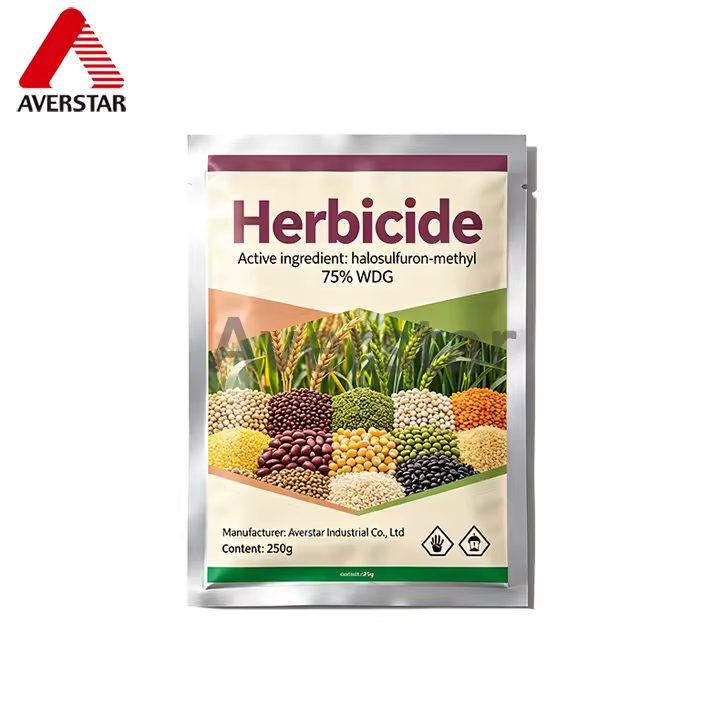
Sulfonylurea herbicides are used at a few grams of active ingredient per hectare, yet they include some of the most widely sold herbicides for cereals, rice and maize. Buyers often see several of them in one quotation. They share a mode of action, but each is selective for particular crops, some stay active in soil much longer than others, and all of them demand careful sprayer cleaning. Selection starts with the crop, the weeds and the next crop in the rotation.
Averstar's catalogue lists tribenuron-methyl 75% WG and WP, metsulfuron-methyl 200 g/kg WP, sulfosulfuron 75% WG, flucarbazone-sodium 70% WG, halosulfuron-methyl 75% WDG, pyrazosulfuron-ethyl 10% WP, bensulfuron-methyl 10% WP and rimsulfuron 25% OF. This guide explains how to match them to crops, what to check about residual activity and which documents to request. The approved destination-market label always decides the permitted crops, dose, timing and restrictions for the product actually supplied.
Quick answer: Match the active to the crop on the label: tribenuron, metsulfuron, sulfosulfuron and flucarbazone for cereals; pyrazosulfuron, bensulfuron and halosulfuron for rice; rimsulfuron for maize and potatoes. All are HRAC Group 2, so check rotational intervals, plan tank cleaning and rotate with other groups.
What sulfonylurea herbicides do
Sulfonylureas inhibit acetohydroxyacid synthase (AHAS, also called ALS), which plants need to make the amino acids valine, leucine and isoleucine. The HRAC global herbicide classification places ALS inhibitors in Group 2. Flucarbazone-sodium belongs to a related chemical family but inhibits the same enzyme, so it sits in the same group. Crops tolerate a given active because they break it down quickly, which is why each active is selective for particular crops only.
Group 2 is one of the groups with the most reported resistant weed populations. Where weeds already survive ALS inhibitors, any product in this guide may perform poorly on them, so ask the local adviser which species escaped earlier sprays.
Match the active to the crop
University of Hertfordshire Pesticide Properties Database (PPDB) records describe the actives as follows:
- Cereals: tribenuron-methyl is a foliar-acting post-emergence herbicide for broadleaf weeds in cereals and some other crops. Metsulfuron-methyl controls weeds mainly in cereals and has contact and residual action. Sulfosulfuron controls annual grasses and broadleaf weeds in wheat and triticale. Flucarbazone-sodium controls grasses such as wild oats and foxtail, plus some broadleaf weeds, in wheat.
- Rice: pyrazosulfuron-ethyl controls broadleaf weeds, grasses and sedges in rice. Bensulfuron-methyl controls annual and perennial weeds and sedges. Halosulfuron-methyl controls broadleaf weeds and sedges, particularly in rice, and is also used in maize, sugarcane and turf.
- Maize and potatoes: rimsulfuron controls annual grasses and broadleaf weeds in maize, potatoes, tomatoes and some fruit crops.
A cereal herbicide cannot be used in rice, or a rice herbicide in maize, unless the label in the destination market lists that crop.
Residual activity and sprayer cleaning
Some sulfonylureas remain active in soil long enough to injure sensitive crops planted afterwards, and breakdown is usually slower in high-pH soils. Labels therefore set rotational intervals, which can differ sharply between actives; metsulfuron-methyl in particular has residual action. Record the crops the grower plans to plant next before choosing a product.
Because sulfonylureas are active at very low concentrations, a small residue left in a sprayer can injure the next crop it treats. Labels describe a cleaning procedure for tanks, lines and nozzles; include it in distributor training, particularly where the same sprayer moves between cereals and broadleaf crops.
Compare the catalogue formulations
- Cereals: Tribenuron-methyl 75% WG and 75% WP contain the same concentration as water-dispersible granules and as a wettable powder; granules are generally less dusty to handle. Metsulfuron-methyl 200 g/kg WP (20% by weight), Sulfosulfuron 75% WG and Flucarbazone-sodium 70% WG complete the cereal group.
- Rice: Pyrazosulfuron-ethyl 10% WP, Bensulfuron-methyl 10% WP and Halosulfuron-methyl 75% WDG. Two rice mixtures pair these actives with other partners: cyhalofop-butyl + halosulfuron-methyl OD adds a Group 1 grass herbicide, while bispyribac-sodium + bensulfuron-methyl WP combines two Group 2 actives, as explained in our bispyribac guide.
- Maize: Rimsulfuron 25% OF. Confirm with the supplier which formulation the code refers to and how the product is diluted, because oil-based flowables are handled differently from water-dispersible granules.
Penn State Extension's overview of pesticide formulations compares granules, powders and liquids. For quality checks, ask for dispersibility, wet sieve and suspensibility results, as described in FAO/WHO pesticide specifications, and keep granules and powders dry.
A product selection checklist
- The crop on the destination-market label: cereal, rice, maize or another listed crop.
- Target weeds by species, including grasses and sedges, and any history of ALS-resistant weeds.
- The rotational crops planned and the label's re-cropping intervals, considering soil pH.
- The sprayer cleaning procedure for distributor and grower training.
- Concentration and unit (% or g/kg) matched on quotation, certificate of analysis and label.
- Formulation tests: dispersibility and wet sieve for WG, suspensibility for WP.
- Moisture-proof packaging, safety data sheet and translated label artwork.
Build the inquiry around the intended use
Send the crop, the target weeds, the rotation, the preferred active and concentration, the packaging and the destination market through our contact form. For a first order, a pesticide sample evaluation plan helps compare samples against the agreed specification before scaling up.
Frequently asked questions
Why do sulfonylurea labels insist on cleaning the sprayer?
Because these herbicides are active at very low concentrations. A small residue left in the tank, lines or nozzles can injure the next sensitive crop sprayed, so the label's cleaning procedure should be followed after every use.
Is flucarbazone-sodium a sulfonylurea?
Not chemically, but it inhibits the same ALS enzyme and is in HRAC Group 2. For resistance management, treat it like the sulfonylureas.
Can tribenuron-methyl be used in rice?
Not unless the destination-market label lists rice. For rice, choose an active registered for it, such as pyrazosulfuron-ethyl, bensulfuron-methyl or halosulfuron-methyl, as the label allows.
Authoritative references
- Global Herbicide Classification Lookup - Herbicide Resistance Action Committee
- PPDB: Tribenuron-methyl - University of Hertfordshire PPDB
- PPDB: Metsulfuron-methyl - University of Hertfordshire PPDB
- PPDB: Sulfosulfuron - University of Hertfordshire PPDB
- PPDB: Flucarbazone-sodium - University of Hertfordshire PPDB
- PPDB: Pyrazosulfuron-ethyl - University of Hertfordshire PPDB
- PPDB: Bensulfuron-methyl - University of Hertfordshire PPDB
- PPDB: Halosulfuron-methyl - University of Hertfordshire PPDB
- PPDB: Rimsulfuron - University of Hertfordshire PPDB
- Pesticide Formulations - Penn State Extension
- Pesticide Specifications and Quality Control (FAO/WHO JMPS) - FAO