
Averstar Chemical Editorial Team Updated November 7, 2026
Azamethiphos, Tricosene, DEET and Flocoumafen: Public Health Pest Control Guide
Public health pest control covers flies, mosquitoes and other biting insects, and rodents in homes, food premises, farms and public buildings. The products differ from crop protection products in how they are used and regulated: many are baits, attractants or repellents, and in many markets they are registered under public-health, biocide or personal-care rules rather than agricultural rules. Buyers therefore need to know the registration route as well as the target pest.
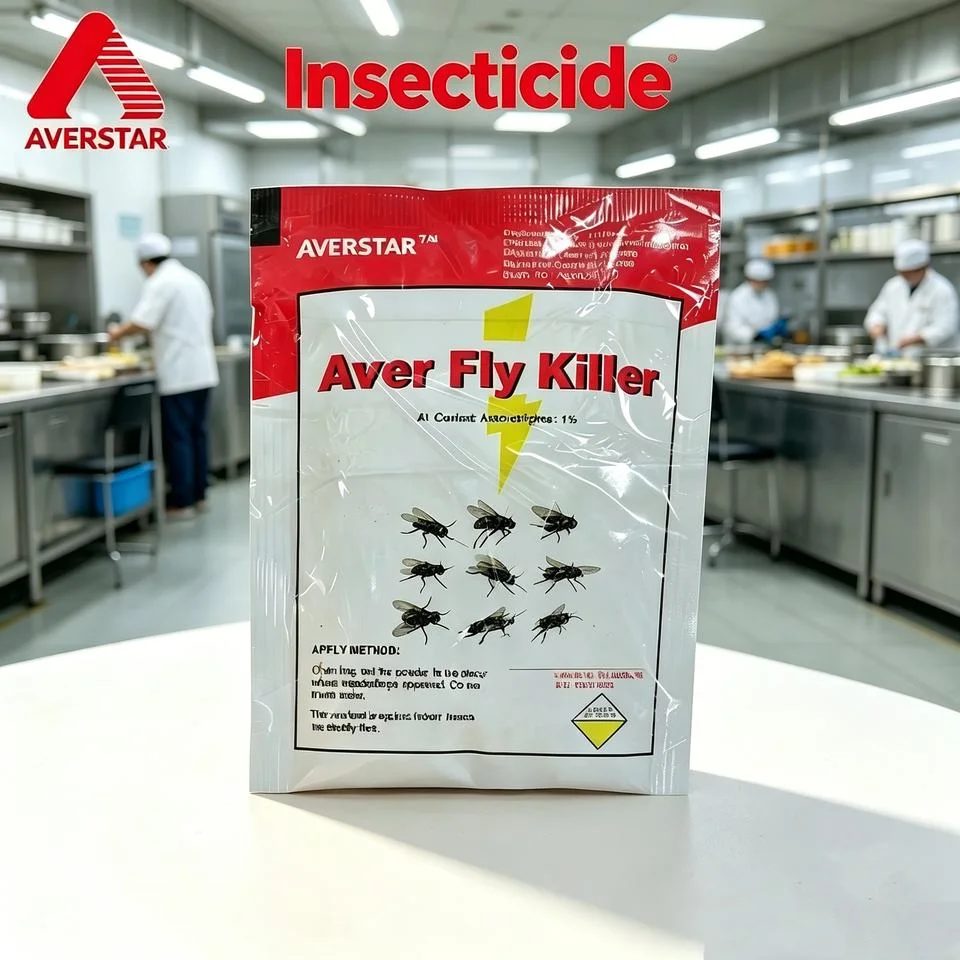
Averstar's catalogue lists azamethiphos 1% fly bait, cis-9-tricosene 90% technical material, DEET 99% technical material and flocoumafen 0.005% rodent bait. This guide explains what each does and which documents to request. The approved destination-market label always decides the permitted situations, dose, placement and restrictions for the product actually supplied.
Quick answer: Use azamethiphos bait against houseflies where it is registered, cis-9-tricosene as the fly attractant in baits and traps, DEET as the active in personal insect repellents, and flocoumafen bait against rats and mice, including populations resistant to other anticoagulants. Each sits under its own registration route, so confirm that first.
Fly control: azamethiphos and cis-9-tricosene
The University of Hertfordshire Pesticide Properties Database (PPDB) describes azamethiphos as a residual organophosphorus insecticide for fly control, with contact and stomach action and rapid knockdown, used in residences and other buildings against houseflies, cockroaches and other pests. It inhibits acetylcholinesterase, which the IRAC mode of action classification places in Group 1B. The azamethiphos 1% product is a fly bait applied as its label describes.
The Bio-Pesticides Database (BPDB) describes muscalure, also known as cis-9-tricosene, as the sex pheromone of the housefly, used to attract flies to traps, sticky papers and baits in animal houses and public and domestic buildings; products may combine it with a knockdown insecticide. The cis-9-tricosene 90% TC is technical material for bait and trap manufacturers. Flies resistant to organophosphates are common in some areas, so fly programmes also rely on sanitation and rotation with other groups; our organophosphate guide covers Group 1B in more detail.
DEET for personal insect repellents
The PPDB describes diethyltoluamide (DEET) as an insect repellent applied to skin and clothing to protect against bites from mosquitoes, ticks, fleas, sandflies, gnats and other pests. It repels rather than kills, and it is usually formulated as aerosol sprays, lotions or wipes. The DEET 99% TC is technical material for repellent manufacturers, who set the concentration of the finished product according to the rules of each market.
Flocoumafen for rats and mice
The PPDB describes flocoumafen as a second-generation anticoagulant rodenticide, especially useful against rodents that have become resistant to other anticoagulants. It blocks the vitamin K cycle that blood clotting depends on, and it is usually supplied as ready-to-use block or pellet baits containing 0.005% active ingredient, the strength of the flocoumafen 0.005% bait. Our brodifacoum bait guide covers another second-generation anticoagulant.
Registration and safety
Second-generation anticoagulants are highly toxic to mammals; the PPDB lists an acute oral LD50 of 0.25 mg/kg for flocoumafen in rats. Pets, children and wildlife that eat bait, or poisoned rodents, can be harmed, so labels usually require tamper-resistant bait stations, restrict where bait can be placed and require removal of dead rodents. Baits commonly contain a bittering agent and a dye as additional safeguards.
Fly baits must be placed where food, people and animals cannot contact them, as the label describes. Repellents containing DEET are regulated in many markets as personal-care or biocidal products, with rules on concentration and labelling. Confirm the registration route and status of each product in the destination market before preparing samples or artwork.
A product selection checklist
- The registration route in the destination market: public health, biocide, personal care or agriculture.
- Target pest and situation: houseflies, biting insects, rats or mice, indoors or outdoors.
- For technical material: the purity specification and the buyer's formulation licence or registration.
- Bait placement rules, bait stations and additives required by the registration.
- Resistance history, such as organophosphate-resistant flies or anticoagulant-resistant rodents.
- Concentration and unit matched on quotation, certificate of analysis and label.
- Packaging, safety data sheet and translated label artwork.
Build the inquiry around the intended use
Send the target pest and situation, the registration route, the preferred product and concentration, the packaging and the destination market through our contact form. For a first order, a pesticide sample evaluation plan helps compare samples against the agreed specification before scaling up.
Frequently asked questions
What is cis-9-tricosene used for?
It is the housefly sex pheromone, also called muscalure. Manufacturers add it to fly baits, traps and sticky papers to attract flies, often together with an insecticide such as azamethiphos.
Can DEET technical material be sold directly to consumers?
No. DEET 99% TC is a raw material for manufacturers of repellent sprays, lotions and wipes, which are registered and labelled for consumer use in each market.
Why choose flocoumafen over first-generation rodenticides?
The PPDB notes that flocoumafen is especially useful against rodents resistant to other anticoagulants. Its higher toxicity also means stricter placement rules, so follow the label closely.
Authoritative references
- PPDB: Azamethiphos - University of Hertfordshire PPDB
- IRAC Mode of Action Classification - Insecticide Resistance Action Committee
- BPDB: Muscalure - University of Hertfordshire BPDB
- PPDB: Diethyltoluamide - University of Hertfordshire PPDB
- PPDB: Flocoumafen - University of Hertfordshire PPDB