
Averstar Chemical Editorial Team Updated November 4, 2026
Trifloxysulfuron-Sodium WG and Mixtures: Buyer Guide
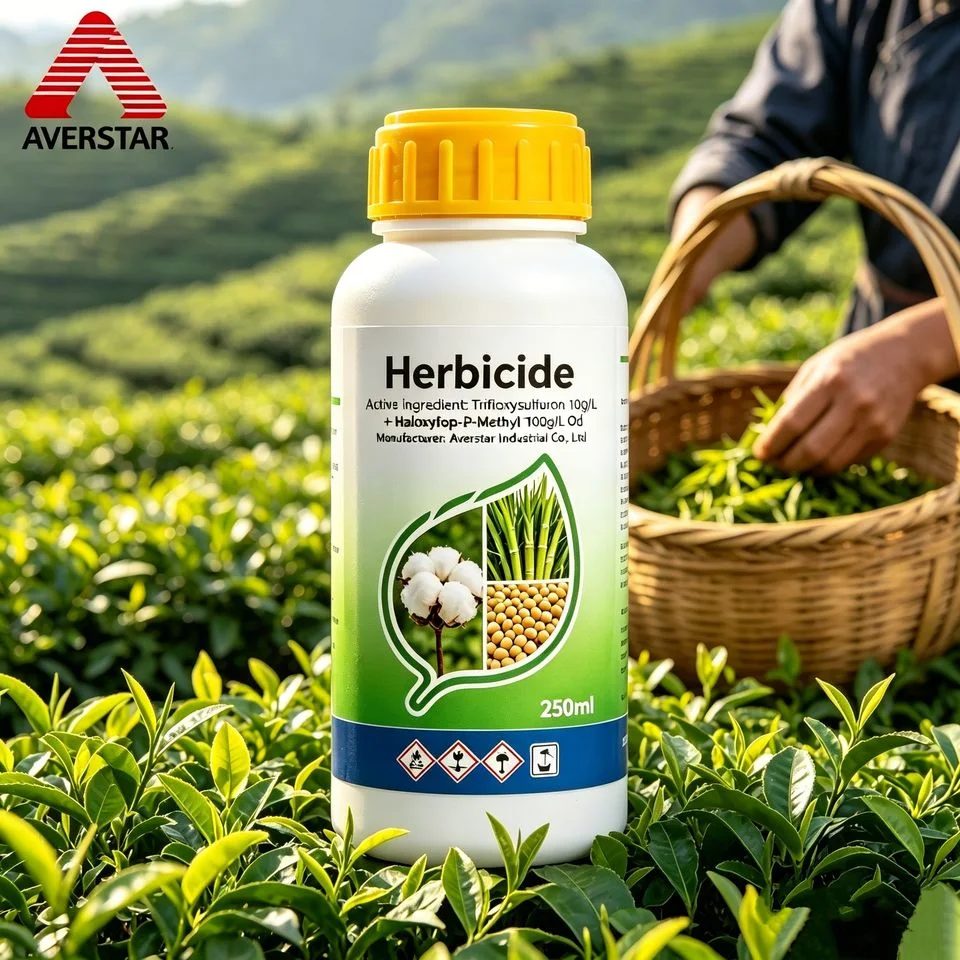
Trifloxysulfuron-sodium is a sulfonylurea herbicide used after crop and weed emergence, and it is sold both as a straight water-dispersible granule and in ready mixtures. For importers and distributors, the first questions are not concentration or price but crop safety and weed spectrum: which crop the label covers, at which crop stage, against which weeds, and what the product means for the next crop in the rotation.
Averstar's catalogue includes trifloxysulfuron-sodium WG and two mixtures, one with ethoxysulfuron and one with haloxyfop-P-methyl. This guide explains what each option adds, how to compare them and which documents to request. The approved destination-market label always decides the permitted crops, dose, timing and restrictions for the product actually supplied.
Quick answer: Start from the crop on the registration, then choose between the straight WG and a mixture according to the weeds that need control. Check whether a mixture partner adds a second herbicide mode of action or only widens the weed spectrum, and confirm rotational-crop restrictions before quoting.
What trifloxysulfuron-sodium does
The University of Hertfordshire Pesticide Properties Database (PPDB) entry for trifloxysulfuron-sodium describes a post-emergence herbicide for grasses, sedges and broadleaf weeds, with example uses in cotton and sugarcane. It is absorbed by shoots and roots, moves within the plant and inhibits acetohydroxyacid synthase (AHAS, also called ALS), an enzyme plants need to make certain amino acids. In the HRAC global herbicide classification, ALS inhibitors form Group 2.
Group 2 is also one of the herbicide groups with the most reported resistant weed populations worldwide. Where ALS-resistant weeds are already present, a Group 2 product may perform poorly on them however well it is formulated. Ask the local adviser which weeds escaped earlier ALS-inhibitor applications before positioning the product.
Registration status differs by country: the PPDB record, for example, lists trifloxysulfuron as not approved under Great Britain's pesticide rules. Confirm the status in each destination market before preparing samples or label artwork.
Crop safety is the first selection question
Selectivity in sulfonylurea herbicides is crop-specific. A label that allows trifloxysulfuron-sodium in one crop says nothing about another, and the same crop can be sensitive at some growth stages or under some application methods. Labels can also restrict which crops may be planted afterwards, because some sulfonylureas persist in soil long enough to injure sensitive rotational crops.
Before comparing products, record:
- The crop and the crop growth stage at application.
- Whether the label requires a directed or a broadcast spray.
- The rotational crops the grower plans to plant next and the re-cropping intervals on the label.
- The dominant weeds by species, not only "grasses" or "broadleaf weeds".
Compare the catalogue options
- Trifloxysulfuron Sodium 20% / 75% WG: the straight active as water-dispersible granules, which the PPDB notes is the usual formulation. The listing covers two concentrations; they are different registered products, so the quotation, certificate of analysis and label should all name the same one. A higher concentration means less formulated product per hectare, not a wider weed spectrum.
- Trifloxysulfuron + ethoxysulfuron 20% / 10% WG: the PPDB describes ethoxysulfuron as a herbicide for broadleaf weeds and sedges that also inhibits AHAS. Both partners are therefore Group 2. The mixture can widen the range of weeds controlled, but it does not add a second mode of action for resistance management.
- Trifloxysulfuron + haloxyfop-P-methyl 10 g/L / 100 g/L OD: haloxyfop-P-methyl is an ACCase-inhibiting grass herbicide in HRAC Group 1. It adds a second mode of action aimed at grass weeds, but it also limits where the mixture can be used: grass herbicides of this type are used in broadleaf crops, so the mixture's own label, not the trifloxysulfuron component, defines the permitted crops. OD means oil dispersion, an oil-based liquid in which the active particles are suspended.
Check the formulation quality
For WG products, ask for the certificate of analysis together with the formulation properties the buyer tests, typically dispersibility, wet sieve residue and dustiness, as described in FAO/WHO pesticide specifications. Granules must stay dry: confirm the inner liner and carton protect against humidity during sea freight. For the OD mixture, ask how dispersion stability and settling on storage are tested, and how the product should be re-mixed before use. Penn State Extension's overview of pesticide formulations explains the handling differences between granule and liquid formats.
A product selection checklist
- The crop, crop stage and application method on the destination-market label.
- The target weeds by species, and any history of weeds escaping ALS-inhibitor herbicides.
- Straight WG or mixture, and whether the partner adds a second HRAC group.
- Rotational-crop restrictions and re-cropping intervals.
- Concentration and unit matched on quotation, certificate of analysis and label.
- Formulation test results: dispersibility and wet sieve for WG, dispersion stability for OD.
- Moisture-proof packaging and the safety data sheet in the destination language.
Build the inquiry around the intended use
Send the crop and crop stage, the target weeds, the preferred product (straight WG or a named mixture), the concentration, packaging and destination market through our contact form. For a first order, a pesticide sample evaluation plan helps compare samples against the agreed specification before scaling up.
Frequently asked questions
Does a 75% WG work better than a 20% WG?
No. The concentration changes how much product is needed per hectare and the packaging and freight cost, not the weeds the active controls. Compare the two on registration status, label rate and formulation quality.
Is trifloxysulfuron + ethoxysulfuron a two-mode-of-action mixture?
No. Both actives inhibit AHAS and belong to HRAC Group 2. The mixture broadens the weed spectrum, but for resistance management it counts as a single mode of action.
Can the haloxyfop-P-methyl mixture be used in sugarcane?
Do not assume so. Haloxyfop-P-methyl is a grass herbicide, and sugarcane is a grass. Use the mixture only in the crops its own registration lists in the destination market.
Authoritative references
- PPDB: Trifloxysulfuron-sodium - University of Hertfordshire PPDB
- Global Herbicide Classification Lookup - Herbicide Resistance Action Committee
- PPDB: Ethoxysulfuron - University of Hertfordshire PPDB
- PPDB: Haloxyfop-P-methyl - University of Hertfordshire PPDB
- Pesticide Specifications and Quality Control (FAO/WHO JMPS) - FAO
- Pesticide Formulations - Penn State Extension