
Averstar Chemical Editorial Team Updated November 12, 2026
Late Blight and Downy Mildew Fungicides: Metalaxyl-M, Dimethomorph, Cymoxanil and Protectants
Late blight of potato and tomato, caused by Phytophthora infestans, and the downy mildews of grapes, cucurbits, lettuce and other crops are among the most destructive crop diseases. Their pathogens are oomycetes, or water moulds, which differ biologically from true fungi. That is why late blight and downy mildew programmes rely on a specific set of fungicides, and why a product chosen for rust or powdery mildew may do nothing against them.
Averstar's catalogue covers the main groups used against these diseases: metalaxyl and metalaxyl-M mixtures, dimethomorph, cymoxanil with mancozeb, and the multi-site protectants mancozeb, copper and chlorothalonil. This guide explains how the groups differ, how they are combined, and which documents to request. The approved destination-market label always decides the permitted crops, diseases, dose, timing and restrictions for the product actually supplied.
Quick answer: Build late blight and downy mildew programmes on a multi-site protectant such as mancozeb, copper or chlorothalonil, and add a single-site partner, such as metalaxyl-M, dimethomorph, cymoxanil or azoxystrobin, where the label allows and disease pressure justifies it. Use single-site groups preventively, in mixtures, and for a limited number of applications per season to slow resistance.
Why oomycetes need their own fungicides
Many oomycetes, such as Phytophthora, Plasmopara, Pseudoperonospora and Pythium, spread by swimming zoospores and thrive in cool, wet or humid weather. The UC Statewide IPM Program describes potato late blight as a disease favoured by cool, damp conditions, whose inoculum can come from infected seed tubers, cull piles, volunteer potatoes, related weeds such as nightshade, and nearby potato or tomato plantings. Grape downy mildew and cucurbit downy mildew are managed in similar ways: protect the crop before infection periods and reduce sources of inoculum.
Oomycetes do not make their own sterols, so the sterol biosynthesis inhibitors that control many true fungi, such as the triazoles, are not used against them. Effective products come from a few specific FRAC groups together with multi-site protectants. FRAC's mode-of-action groups list each of them.
Metalaxyl and metalaxyl-M (FRAC Group 4)
The University of Hertfordshire Pesticide Properties Database (PPDB) describes metalaxyl-M as a systemic fungicide with curative and protective action that disrupts nucleic acid synthesis (RNA polymerase I). It lists foliar and tuber blight, late blight and downy mildews among the diseases controlled, on potatoes, tomatoes, hops, lettuce, grapes, tobacco and other crops. Metalaxyl-M, also called mefenoxam, is the active isomer of metalaxyl, which the PPDB lists for downy mildew, foliar and tuber blight and damping-off. Both are phenylamides in FRAC Group 4.
Phenylamide resistance is the main concern. The UC IPM guidelines note that strains of Phytophthora infestans have developed resistance to mefenoxam, and the FRAC phenylamide expert forum publishes the use recommendations. For this reason most end-use products combine metalaxyl-M with a protectant partner. Averstar's catalogue includes:
- Metalaxyl 50% WP, the single active
- Copper oxychloride + metalaxyl-M 35% / 15% WP
- Metalaxyl-M + copper oxide 6% / 60% WP
- Cuprous oxide + metalaxyl-M 600 g/L / 60 g/L WP
- Azoxystrobin + metalaxyl-M 322 g/L / 124 g/L SE
- Hymexazol + metalaxyl-M 25% / 5% SL, used against seedling and soil-borne diseases where registered
Our metalaxyl product selection guide and the oomycete program page cover these mixtures in more detail.
Dimethomorph (FRAC Group 40)
The PPDB describes dimethomorph as a systemic fungicide with good protective activity that inhibits cellulose synthesis. It lists downy mildew, late blight, Phytophthora root and crown rots among the diseases controlled, on grapevines, cucurbits, lettuce, onions, potatoes and soft fruit. Dimethomorph is a carboxylic acid amide (CAA) in FRAC Group 40, and the FRAC CAA working group issues the resistance recommendations for the group.
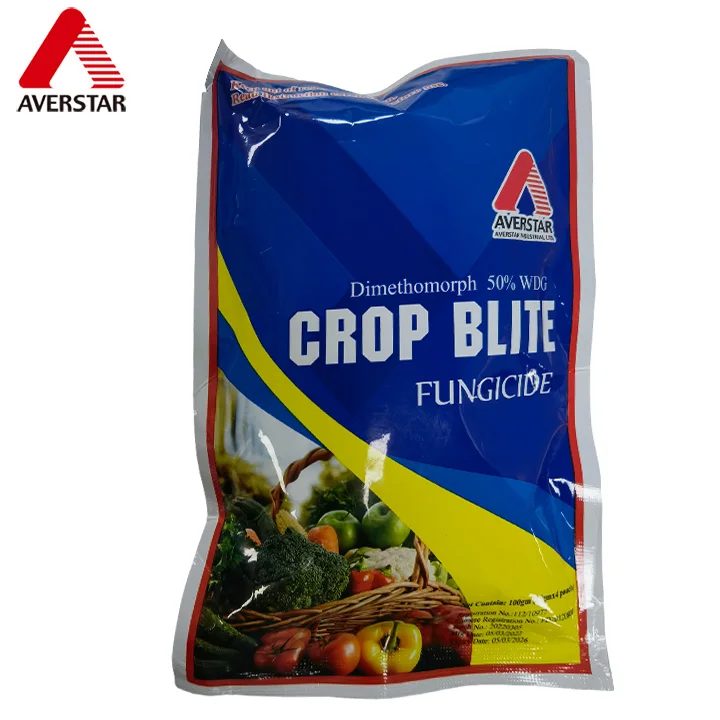
The catalogue lists dimethomorph 50% WG, dimethomorph 50% WDG and dimethomorph 80% WDG. WG and WDG both describe water-dispersible granules; the registered label states which name and concentration apply. The PPDB records dimethomorph as not approved in the European Union, so check residue limits for produce exported there. Our dimethomorph buyer guide compares the granule products.
Cymoxanil (FRAC Group 27)
The PPDB describes cymoxanil as a foliar fungicide with protective and curative activity, used against late blight and downy mildew on potatoes, tomatoes, grapes and hops. It is a cyanoacetamide oxime in FRAC Group 27. Cymoxanil is usually sold in mixtures, most often with mancozeb, so that the multi-site protectant supplies broad, longer-lasting cover while cymoxanil adds activity against infections that have just started.
Averstar lists the same composition in two configurations: cymoxanil + mancozeb 8% / 64% WP and mancozeb + cymoxanil 64% / 8% WP. Match the order of actives and the concentrations to the registration you hold.
Multi-site protectants: mancozeb, copper and chlorothalonil
Multi-site fungicides act on many processes in the pathogen at once, so resistance to them is rare, and they are the base of most late blight and downy mildew programmes. They work on the plant surface and must be in place before infection.
- Mancozeb (FRAC M03): the PPDB describes mancozeb as a broad-spectrum, non-systemic contact fungicide with protective action and multi-site activity, used against potato blight, leaf spots, scab and rust. Averstar supplies mancozeb 80% WP; see our mancozeb buyer guide.
- Copper (FRAC M01): the PPDB describes copper oxychloride as a protectant copper fungicide and bactericide used as a foliar spray against downy mildew and leaf spots, and copper(I) oxide as a multi-site protectant that stops spores entering host tissue. Averstar supplies copper oxychloride 45% WP and the copper mixtures listed above.
- Chlorothalonil (FRAC M05): the PPDB describes chlorothalonil as a non-systemic, broad-spectrum, multi-site fungicide that prevents spore germination and zoospore motility, used against downy mildew and leaf blights. Averstar supplies chlorothalonil 75% WP.
The PPDB records mancozeb and chlorothalonil as not approved in the European Union, while copper compounds remain approved there. Check residue limits in each importing market before choosing a protectant for export crops. Our protectant fungicide guide compares these products.
Azoxystrobin, a QoI partner
The PPDB describes azoxystrobin as a broad-spectrum strobilurin with systemic, translaminar and protectant action that inhibits respiration, and lists early and late blight among the diseases it controls. It belongs to the quinone outside inhibitors (QoI) in FRAC Group 11, a high-risk group with its own FRAC QoI working group. In the catalogue, it is combined with metalaxyl-M in the azoxystrobin + metalaxyl-M SE listed above. Our azoxystrobin buyer guide covers the single-active products.
Resistance management
Phenylamides and QoI fungicides are high-risk groups. For the CAA group, FRAC reports grape downy mildew isolates resistant to all CAA fungicides in certain regions, while the late blight isolates it describes were sensitive. FRAC's recommendations for phenylamide and CAA fungicides share a common pattern:
- Apply them preventively, before infection is established, rather than as a rescue treatment.
- Use them in mixtures with an effective partner from a different group, usually a multi-site protectant.
- Limit the number of applications of each group per season to what the label and local guidance allow.
- Alternate groups between applications and combine sprays with resistant varieties, clean seed tubers, removal of cull piles and volunteers, and forecasts of infection periods.
Cornell's late blight fact sheet and our fungicide mode-of-action guide give more background.
Compare the catalogue formulations
- WP (wettable powder): used for most mancozeb, copper, chlorothalonil and metalaxyl products; check wettability and suspensibility.
- WG / WDG (water-dispersible granules): used for dimethomorph; less dust than a powder.
- SE (suspo-emulsion): combines a suspended solid and an emulsified liquid active, as in azoxystrobin + metalaxyl-M.
- SL (soluble concentrate): dissolves fully in water, as in hymexazol + metalaxyl-M.
Penn State Extension's overview of pesticide formulations explains these types, and FAO/WHO pesticide specifications describe the properties buyers test.
A product selection checklist
- The crop and the confirmed disease: late blight, a specific downy mildew, or a soil-borne Pythium or Phytophthora problem.
- The protectant base of the programme and the single-site groups already used this season.
- Each active, its concentration basis and the formulation, matched to the destination-market registration.
- Residue limits in the importing market for treated produce, especially for mancozeb, chlorothalonil and dimethomorph.
- For copper products: the copper compound and whether content is stated as the compound or as metallic copper.
- Packaging, safety data sheet, batch certificate of analysis and translated label artwork.
Build the inquiry around the disease
Send the crop, the target disease, the protectant you already use, the preferred product and concentration, the packaging and the destination market through our contact form. For a first order, a pesticide sample evaluation plan helps compare samples against the agreed specification before scaling up.
Frequently asked questions
Why don't triazole fungicides control late blight or downy mildew?
Their pathogens are oomycetes, which do not make their own sterols. Triazoles work by blocking sterol biosynthesis, so they are not used against these diseases. Programmes rely on phenylamides, CAA fungicides, cymoxanil, QoI fungicides and multi-site protectants instead.
Is metalaxyl the same as metalaxyl-M?
No. Metalaxyl-M, also called mefenoxam, is the active isomer of metalaxyl. Both are phenylamides in FRAC Group 4, so they share resistance, but their concentrations, registrations and labels are separate. Match the exact name on the registration.
Why is cymoxanil usually combined with mancozeb?
Cymoxanil adds protective and curative activity inside the leaf, while mancozeb provides broad, multi-site surface protection. The combination covers more of the infection cycle and reduces the selection pressure on cymoxanil. Each mixture is registered as its own product.
Authoritative references
- Late Blight / Potato: Pest Management Guidelines - UC Statewide IPM Program
- Downy Mildew / Grape: Pest Management Guidelines - UC Statewide IPM Program
- Downy Mildew / Cucurbits: Pest Management Guidelines - UC Statewide IPM Program
- FRAC Mode of Action Groups - Fungicide Resistance Action Committee
- PPDB: Metalaxyl-M - University of Hertfordshire PPDB
- PPDB: Metalaxyl - University of Hertfordshire PPDB
- Phenylamides – FRAC Expert Forum - Fungicide Resistance Action Committee
- PPDB: Dimethomorph - University of Hertfordshire PPDB
- CAA Fungicides – FRAC Working Group - Fungicide Resistance Action Committee
- PPDB: Cymoxanil - University of Hertfordshire PPDB
- PPDB: Mancozeb - University of Hertfordshire PPDB
- PPDB: Copper oxychloride - University of Hertfordshire PPDB
- PPDB: Copper I oxide - University of Hertfordshire PPDB
- PPDB: Chlorothalonil - University of Hertfordshire PPDB
- PPDB: Azoxystrobin - University of Hertfordshire PPDB
- QoI Fungicides – FRAC Working Group - Fungicide Resistance Action Committee
- Late Blight – Cornell Vegetables - Cornell University
- Pesticide Formulations - Penn State Extension
- Pesticide Specifications and Quality Control (FAO/WHO JMPS) - FAO