
Averstar Chemical Editorial Team Updated August 30, 2026
2,4-D Herbicide for Importers: Salt Forms, Esters and Mixtures
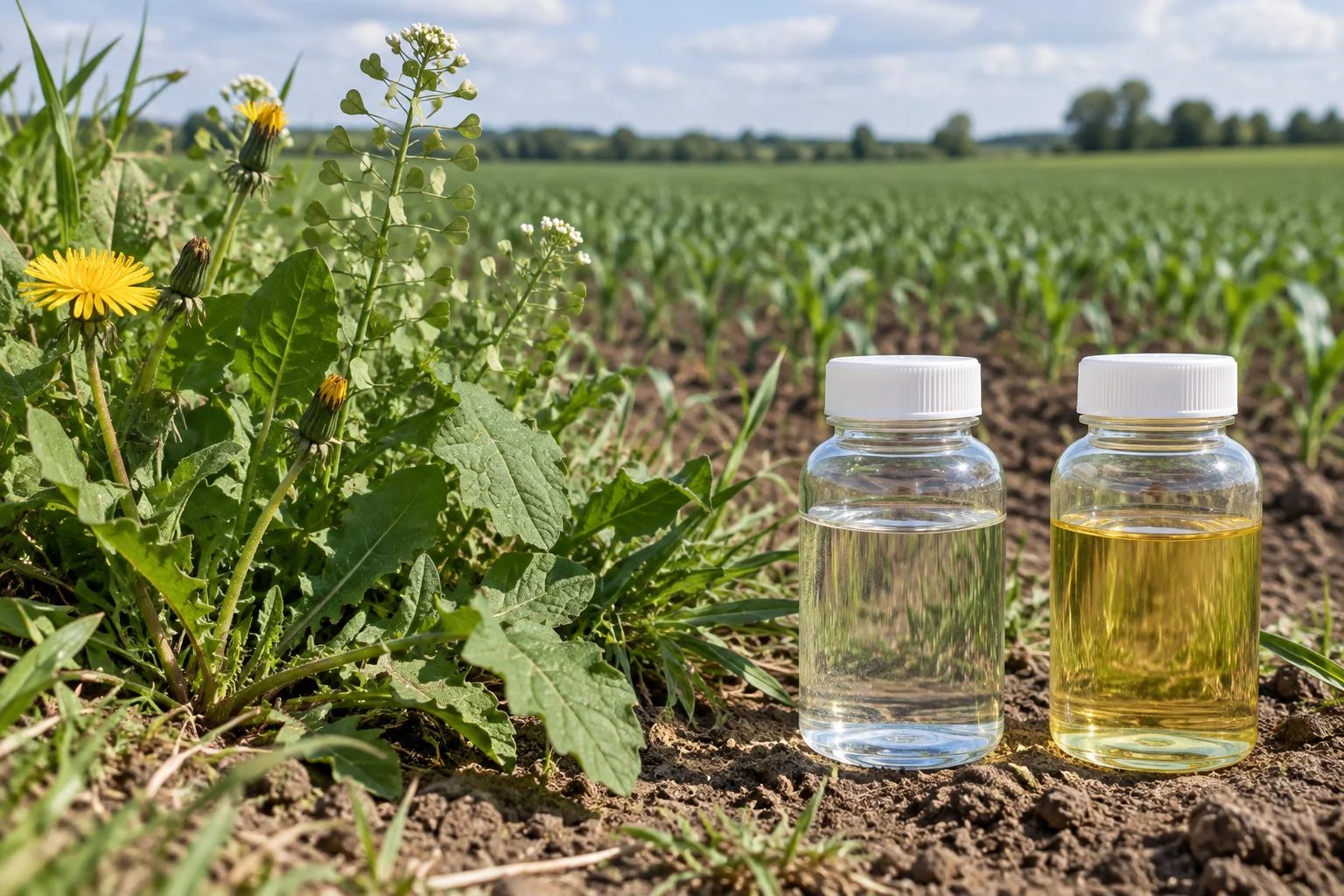
2,4-D Herbicide for Importers: Salt Forms, Esters and Mixtures
This guide explains how professional buyers can compare 2,4-D offers before shortlisting suppliers. It is an educational sourcing resource, not an application recommendation, product label or legal opinion. Product approval, label directions and commercial legality must always be verified for the destination jurisdiction.
2,4-D is a synthetic auxin herbicide classified by HRAC in Group 4, used against broadleaf weeds in cereal, maize, sugarcane, pasture and non-crop programmes. It is one of the oldest and most widely traded herbicide actives, which means the commercial landscape is crowded and offers differ in ways a product name does not reveal: the chemical form, the concentration basis and the drift-management position of the destination market.
Salt or ester: the first identity check
2,4-D is commercially supplied in several forms — amine salts in water-based SL formulations and ester forms in solvent-based formulations. The form changes volatility behaviour, and many jurisdictions regulate ester use near sensitive crops or in hot seasons. It also changes the arithmetic: as with glyphosate, offers may be quoted on the salt or ester content rather than the acid equivalent, so ask every supplier to state the form and the acid-equivalent figure on the certificate of analysis before comparing prices.
Averstar configurations
Averstar lists straight 2,4-D 720g/l SL, a high-load amine-type liquid for broadleaf programmes, and the ready mixture Glyphosate + 2,4-D 30% / 2% SL, which pairs the auxin with a Group 9 partner for broader knockdown use where the mixture is registrable.
For the mixture, every active ingredient must be acceptable in the destination market and the mixture itself normally needs its own registration. Resistance-management positioning — auxin plus EPSPS inhibitor — should be reviewed with local advisers using the current HRAC classification rather than inferred from marketing material.
Drift, neighbouring crops and label conditions
Because 2,4-D injury symptoms on sensitive broadleaf crops are highly visible, destination labels often carry buffer, wind-speed or seasonal restrictions, and complaints between neighbouring farms are a known commercial risk in some markets. A buyer cannot fix that with sourcing alone, but can confirm that the label conditions the destination authority imposes are actually printable and trainable for the intended channel before committing to volume.
Packaging, shipment and sample planning
SL offers are normally quoted in bottles, co-packs, 200 L drums and intermediate bulk containers. Ask each supplier to state packaging materials, net contents per unit and the export carton configuration on the quotation, and confirm that proposed retail pack sizes are acceptable under destination labelling rules before artwork is prepared.
When samples are needed for registration or laboratory verification, agree in writing what the sample represents: the batch, the formulation version and the specification revision. A sample drawn from a pilot batch does not prove that commercial shipments will match, so tie the commercial contract to the certificate of analysis of each shipped batch rather than to the sample alone.
Documents to request before shortlisting
An evidence-led comparison needs the same document set from every candidate supplier: the certificate of analysis, the proposed or registered label, the safety data sheet, the product specification, packaging details and the manufacturing-site identity. Ask for the version and date of each document, and keep the records together so that differences between a quotation, a label and a technical sheet can be resolved before commercial commitments are made.
For adjacent reading, see the glyphosate formulations buyer guide and the herbicide mode-of-action buyer guide.
Registration and residue references
Use the FAO pest and pesticide management resources for framework guidance and the Codex pesticide residues database for internationally referenced maximum residue limits, then confirm current national decisions with the destination authority. Nothing in this guide replaces the registered label or local regulatory advice.
Compare Averstar 2,4-D products
Averstar supplies the 2,4-D configurations linked above with COA, SDS, label and registration documentation support. Browse the herbicides category to compare actives and formulations, and use the quotation form on any product page to confirm current MOQ, packaging options, documents and delivery terms for your destination market.
Frequently asked questions
Why does the amine-versus-ester distinction matter to a buyer?
The form changes volatility behaviour and the label conditions many markets impose, and it changes the concentration arithmetic. Confirm the form and the acid-equivalent figure on the certificate of analysis before comparing offers.
Can a 2,4-D mixture be sold anywhere its components are registered?
Not automatically. The mixture itself normally needs its own registration in the destination market, in addition to each active being acceptable there.
Does this guide recommend application rates or crops?
No. It is a pre-screening resource for sourcing conversations. Use directions, approved crops and rates are governed by the registered label in the destination market.
Authoritative references
- Herbicide mode-of-action and resistance resources - Herbicide Resistance Action Committee (HRAC Global)
- Pest and Pesticide Management - Food and Agriculture Organization of the United Nations (FAO)
- Codex Pesticides Residues Database - Codex Alimentarius Commission (FAO/WHO)