
Averstar Chemical Editorial Team Updated November 7, 2026
Mepiquat Chloride, Paclobutrazol and Cytokinins: Plant Growth Regulator Guide
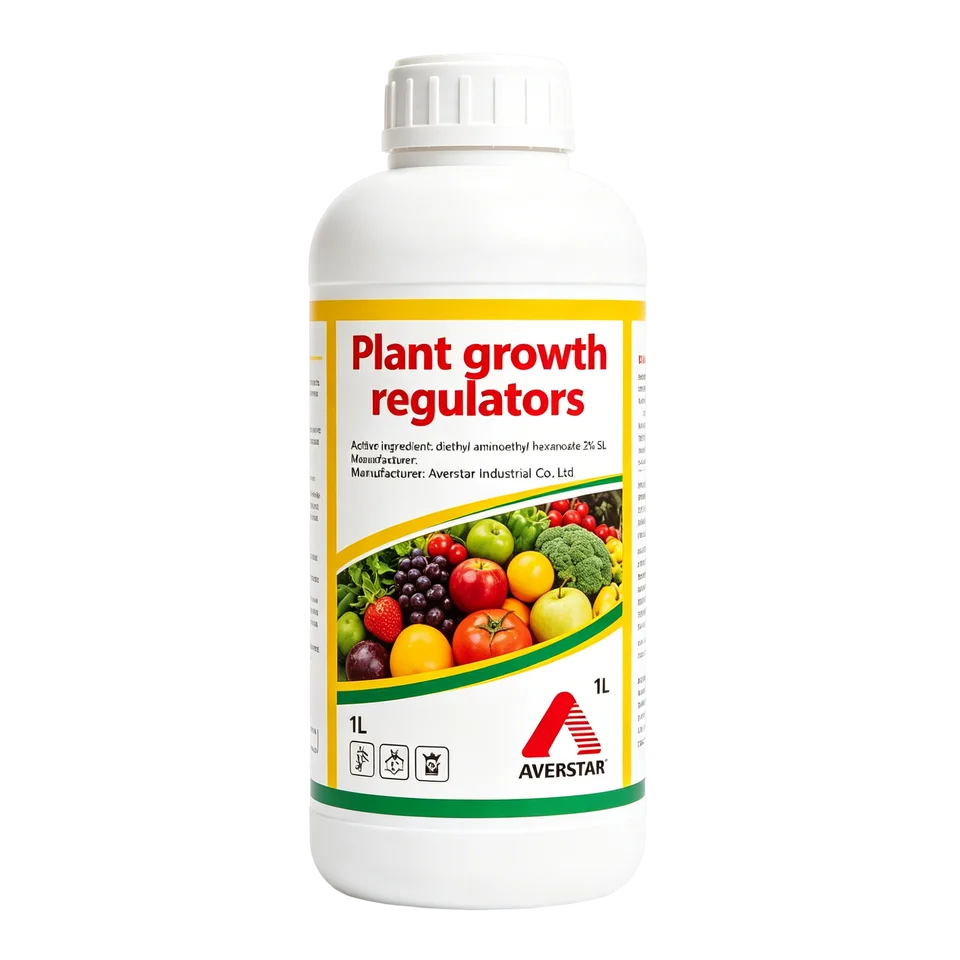
Plant growth regulators fall into groups with opposite purposes. Growth retardants such as mepiquat chloride and paclobutrazol slow shoot growth to manage canopy and plant shape, while cytokinins such as 6-benzylaminopurine and zeatin promote cell division, fruit set or fruit size. Buying the right regulator therefore starts with the result the grower wants and the crop stage, because the wrong product or timing can reduce yield.
Averstar's catalogue lists mepiquat chloride 250 g/L and 5% SL, paclobutrazol 25% SC, 6-benzylaminopurine 98% TC, zeatin 98% TC, diethyl aminoethyl hexanoate (DA-6) 2% SL and butralin 48% EC. This guide explains what each regulator does and which documents to request. The approved destination-market label always decides the permitted crops, timing, concentration and restrictions for the product actually supplied. Our ethephon and gibberellic acid guide covers two more regulators.
Quick answer: Use mepiquat chloride or paclobutrazol to slow vegetative growth, cytokinins to promote cell division and fruit effects, and butralin for tobacco sucker control, each only as the label describes. Technical materials (TC) are for formulators, not growers.
Growth retardants: mepiquat chloride and paclobutrazol
Both actives inhibit gibberellin biosynthesis, which shortens internodes and slows shoot growth.
- Mepiquat chloride: the University of Hertfordshire Pesticide Properties Database (PPDB) describes a regulator used to reduce vegetative growth and improve plant shape by reducing internode elongation. Its example uses include cereals, cotton, onions and grass, with timing and rates tied to crop stage on the label.
- Paclobutrazol: a conazole regulator with some mild fungicidal activity, absorbed through leaves, stems and roots, used in ornamentals, fruit and other crops, such as mango, cotton and grape vines, to inhibit vegetative growth. Because roots also take it up, the label governs both spray and soil application methods and any limits on repeated use.
Cytokinins and DA-6
- 6-Benzylaminopurine (6-BA): the University of Hertfordshire Bio-Pesticides Database (BPDB) describes a synthetic cytokinin that increases cell division, used alone or with gibberellins for fruitlet thinning in orchards and in melons, citrus, ornamentals and cereals.
- Zeatin: a natural cytokinin, produced commercially by biotechnology, used to increase yields, blossom production and growth effects in fruit trees, ornamentals and other crops.
- Diethyl aminoethyl hexanoate (DA-6): a regulator described in the PPDB as increasing crop yields and resistance to infection, with example uses in strawberries, vegetables, rice, ornamentals and turf.
Butralin for sucker control
The PPDB describes butralin as a dinitroaniline pre-emergence herbicide and growth-inhibiting substance whose example use is sucker control in tobacco. As a regulator it is applied after topping to stop axillary shoots growing, according to its label. Our linuron and diuron guide covers its herbicide use in a mixture.
Compare the catalogue formulations
- Mepiquat chloride 250 g/L SL and 5% SL: soluble concentrates. A value of 250 g/L is grams per litre, while 5% may be by weight or by volume, so state the registered unit on every document.
- Paclobutrazol 25% SC: a suspension concentrate that needs agitation before use.
- DA-6 2% SL and Butralin 48% EC: a soluble concentrate and an emulsifiable concentrate.
- 6-BA 98% TC and Zeatin 98% TC: technical materials, traded with a purity specification to buyers who hold a formulation licence or registration; they are not sold to growers for direct use.
Penn State Extension's overview of pesticide formulations compares these types, and FAO/WHO pesticide specifications describe the properties buyers test.
A product selection checklist
- The crop and the intended effect: slowing growth, fruit thinning or set, yield support or sucker control.
- The crop stage and conditions on the label, which regulators depend on closely.
- Concentration and unit matched on quotation, certificate of analysis and label.
- For technical material: the purity specification and the buyer's licence or registration.
- Any label limits on repeated use or soil application, especially for paclobutrazol.
- Packaging, safety data sheet and translated label artwork.
Build the inquiry around the intended use
Send the crop, the intended effect, the preferred product and concentration, the packaging and the destination market through our contact form. For a first order, a pesticide sample evaluation plan helps compare samples against the agreed specification before scaling up.
Frequently asked questions
Can mepiquat chloride and paclobutrazol be swapped?
No. Both slow growth through the same pathway, but they are registered for different crops and uses with their own rates and timing. Use each only as its label describes.
Do cytokinins make every crop yield more?
No. Cytokinin effects depend on the crop, stage, concentration and conditions, and the registered uses are specific, such as fruitlet thinning in orchards. Results outside the label are not predictable.
Can 6-BA or zeatin technical material be sold to farmers?
No. Technical material is the concentrated active ingredient for formulators. Growers use formulated, registered products made from it.
Authoritative references
- PPDB: Mepiquat chloride - University of Hertfordshire PPDB
- PPDB: Paclobutrazol - University of Hertfordshire PPDB
- BPDB: 6-benzyladenine - University of Hertfordshire BPDB
- BPDB: Zeatin - University of Hertfordshire BPDB
- PPDB: 2-diethylaminoethyl hexanoate - University of Hertfordshire PPDB
- PPDB: Butralin - University of Hertfordshire PPDB
- Pesticide Formulations - Penn State Extension
- Pesticide Specifications and Quality Control (FAO/WHO JMPS) - FAO