
Averstar Industrial Co., Ltd Editorial Team Updated August 21, 2026
2,4-D DMA Salt Herbicide: A Buyer Verification Guide
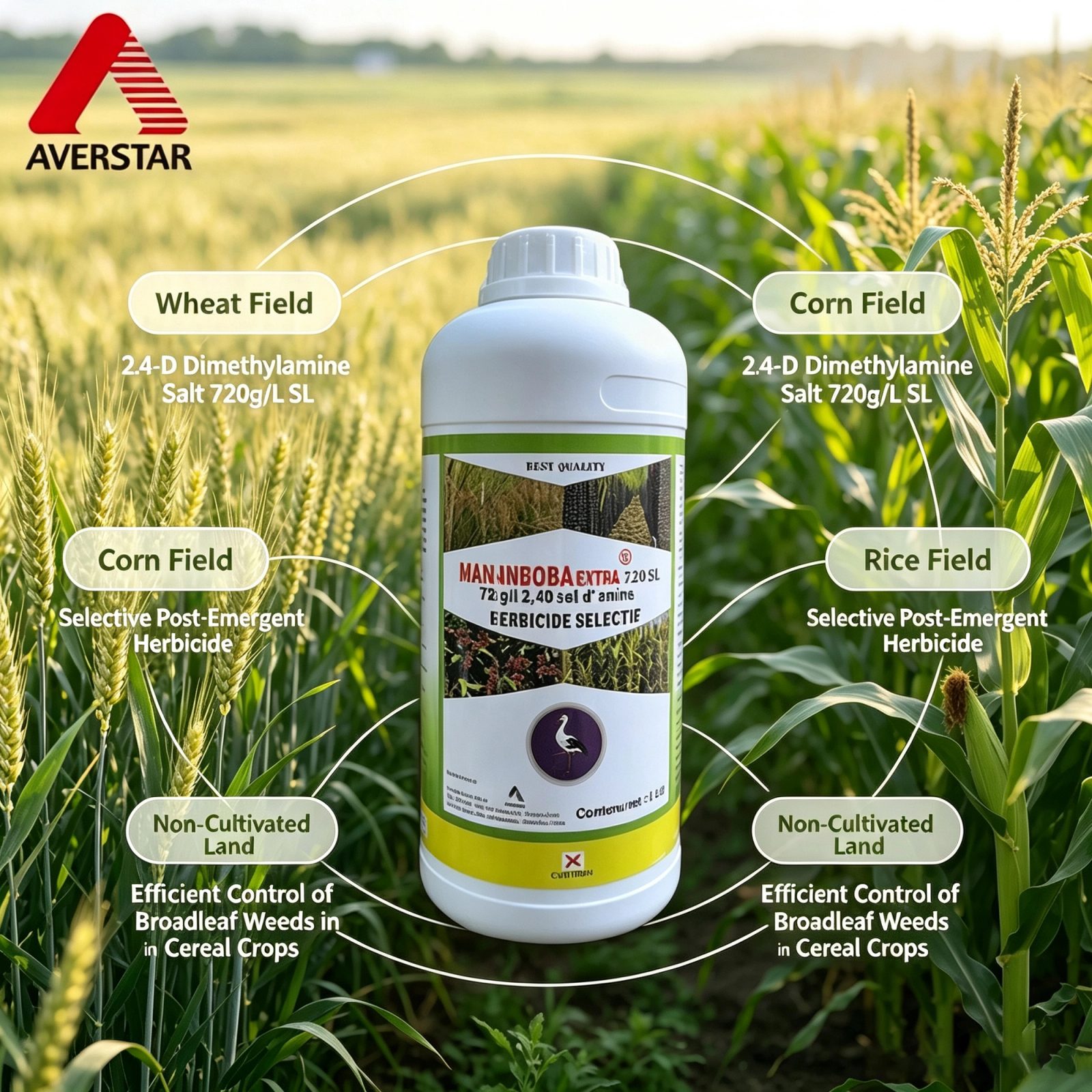
2,4-D DMA Salt Herbicide: A Buyer Verification Guide
2,4-D dimethylamine (DMA) salt is one chemical form used in products based on 2,4-D. For an international buyer, the name alone is not enough to approve a purchase. The supplier specification, acid-equivalent statement, formulation, destination-market registration, approved label, packaging and document set must all be checked together. This guide explains what can be verified from public authorities and what must still be confirmed for the specific commercial product.
Start with the exact chemical identity
The U.S. Environmental Protection Agency describes 2,4-D as a herbicide used for broadleaf-weed control and notes that products may contain acid, salt or ester forms. The National Pesticide Information Center likewise explains that chemical form affects physical behavior, environmental fate and toxicity. A buyer should therefore avoid treating “2,4-D,” “2,4-D acid,” “2,4-D DMA salt” and an ester form as interchangeable descriptions.
The archived NPIC technical fact sheet identifies 2,4-D dimethylamine salt separately from the parent acid and lists CAS Registry Number 2008-39-1 for the DMA salt. The parent 2,4-D acid is commonly identified by CAS Registry Number 94-75-7. Because commercial labels may express concentration as salt, acid equivalent or another basis, the buyer should request a specification that states exactly which basis is used. The SDS, certificate of analysis and label should use compatible identity and concentration information.
Chemical identity checks for the buyer file
- Exact active-ingredient and salt-form name shown on the proposed label and specification.
- Concentration and unit, including whether the value is salt content or acid equivalent.
- Formulation code and physical form, rather than relying only on the active-ingredient name.
- CAS number and other identifiers cross-checked against the SDS and an authoritative chemical source.
- Co-formulated active ingredients, if any, stated separately with their own concentrations.
Do not copy crop or weed claims between markets
A product page cannot establish that a 2,4-D DMA salt formulation is approved for wheat, corn, sugarcane, turf or any other site in every country. Crops, sites, target weeds, timing, application rate, pre-harvest interval, re-entry interval, buffer requirements and use restrictions are label-specific. Buyers should compare the proposed claim set with the current registration and approved label in the destination market. If a market registration is still being developed, the marketing text should remain limited to verified chemical and supply information.
This distinction also protects the buyer from confusing the biological activity of the active ingredient with the legal uses of a finished product. EPA states that 2,4-D products can be used safely when label directions are followed; that statement does not make one label valid in another jurisdiction. Local regulators may approve different forms, concentrations, crops, targets or risk-mitigation measures.
Form and formulation affect risk review
Public references show that different 2,4-D forms can behave differently. NPIC notes that form influences environmental behavior and effects, especially for aquatic organisms, while EPA advises users to follow the specific product label. A DMA-salt description should therefore not be turned into an absolute “no drift” or “safe for all grasses” claim. Spray movement can involve droplets, application conditions, equipment, nearby sensitive plants and label restrictions, not only vapor pressure.
For procurement, ask the supplier to identify the formulation type, appearance, density or other relevant specification limits, storage conditions and compatible packaging. Confirm whether the offered product is a soluble liquid, a concentrate or another formulation defined by the destination label. Packaging material and closure selection should be reviewed against formulation compatibility, transport classification, pack size and local labeling rules.
Resistance stewardship belongs in the review
The Herbicide Resistance Action Committee places 2,4-D among Group 4 auxin-mimic herbicides. This classification helps buyers and technical teams discuss mode-of-action stewardship, but it is not a universal tank-mix recommendation. Resistance-management language, rotation, mixtures and application sequences should follow the approved local label and current agronomic guidance. A supplier should not promise that a mixture will broaden control or overcome resistance without product-specific evidence and authorization.
Documents to request before commercial approval
- Current product specification with active ingredient, concentration basis and formulation clearly stated.
- SDS that matches the proposed product identity, composition and destination-language requirements.
- Representative or batch-specific certificate of analysis, as agreed in the quotation and contract.
- Proposed label artwork and the destination-market approved label or registration reference.
- Packaging specification, container and closure details, carton marks and transport packing plan.
- Available manufacturing, quality and export documents required by the buyer or local authority.
A practical quotation brief
A useful inquiry should state the exact 2,4-D DMA salt specification, concentration basis, formulation, required quantity, destination country, intended registration status, pack sizes, label language, Incoterm, delivery schedule and required documents. This information allows the supplier to confirm what is genuinely available instead of replying with a generic product description.
Before approval, compare the quotation, specification, SDS, certificate of analysis and label side by side. Resolve differences in chemical form, concentration units, product name, manufacturer information and claims in writing. Keep the final approved documents with the purchase contract and shipment record. Where technical or regulatory interpretation is required, use a qualified local agronomist, toxicologist or registration professional.
What this guide does—and does not—confirm
This article confirms general public information about 2,4-D forms and a due-diligence process for buyers. It does not confirm a particular product registration, crop, weed spectrum, application rate, efficacy level, compatibility, safety interval or market availability. Those details must come from the current approved label, regulatory record and commercial documents for the exact product and destination.
Frequently asked questions
Is 2,4-D DMA salt the same as 2,4-D acid?
No. The DMA salt is a distinct chemical form derived from 2,4-D acid. Confirm the exact identity, CAS number and whether concentration is expressed as salt content or acid equivalent.
Does a DMA-salt formulation eliminate drift risk?
No. Chemical form is only one part of risk review. Droplet movement, weather, equipment, nearby sensitive plants and label restrictions must also be considered.
Can a supplier use the same crop and weed claims in every country?
No. Crops, sites, targets, rates and restrictions depend on the approved product label and registration in the destination market.
Which documents should an importer request?
Request the current specification, matching SDS, certificate of analysis arrangements, label or registration reference, packaging specification and required export documents.
Why should buyers check the Group 4 classification?
It supports mode-of-action and resistance-stewardship review. It does not by itself authorize a crop use, mixture, sequence or resistance claim.
Authoritative references
- 2,4-D: Ingredients Used in Pesticide Products - U.S. Environmental Protection Agency
- 2,4-D General Fact Sheet - National Pesticide Information Center, Oregon State University
- Group 4 - Auxin Mimics Resistance - Herbicide Resistance Action Committee