
Averstar Industrial Co., Ltd Editorial Team Updated September 20, 2026
Rice Blast Management: An Integrated Guide for Importers and Crop Advisors
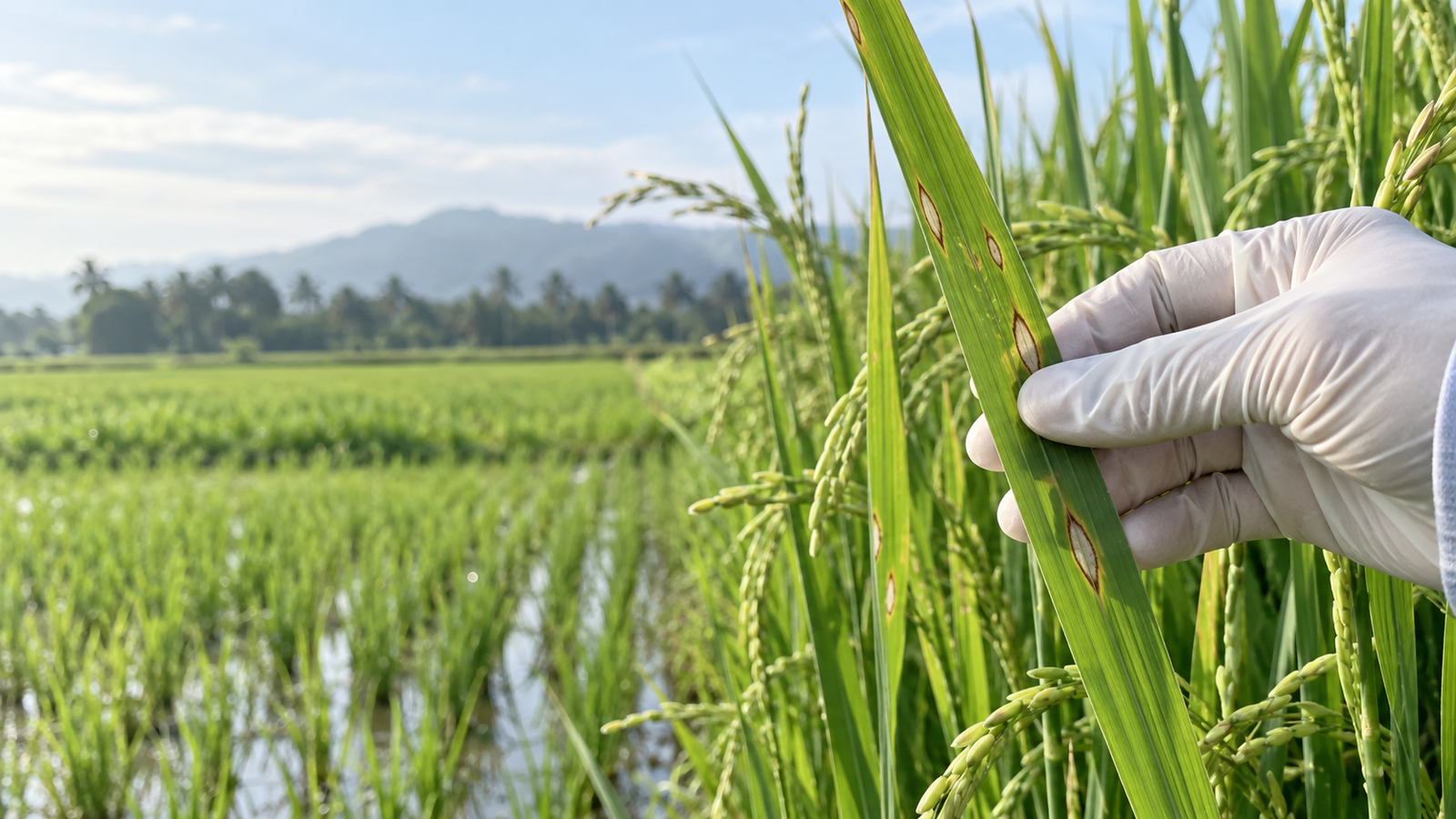
Rice blast is a disease-management and procurement problem, not simply a fungicide-selection problem. The disease is caused by Magnaporthe oryzae and can affect leaves, collars, nodes, necks and panicles. When neck or node infections develop before grain formation, panicles may produce few or no grains. A reliable crop-protection program therefore starts with diagnosis and field-risk assessment, then connects cultural practices, resistant varieties, monitoring and a locally registered fungicide program.
This guide is written for importers, distributors and technical buyers who need to turn a rice-blast requirement into an order-ready product brief. It explains what to ask a supplier, which technical details should be compared, and where a commercial offer must stop until the destination authority or local agronomist confirms the label.
What rice blast looks like
Symptoms vary with the plant part and crop stage. Leaf blast commonly appears as spindle-shaped lesions with gray or pale centers and darker margins. Node and neck blast can create dark lesions that weaken the culm or girdle the neck, causing lodging, whiteheads or poorly filled panicles. These signs can be confused with stem-borer injury, nutrient stress or other rice diseases, so a photograph alone should not be treated as a definitive diagnosis. Field scouting should record variety, crop stage, recent nitrogen applications, weather, water management and the distribution of symptoms.
IRRI describes prolonged rain showers, cool daytime conditions, leaf wetness and large day–night temperature differences as conditions that can favor blast. Excess nitrogen can also produce lush, disease-prone growth. Those observations matter to buyers because the same formulation may be suitable for one production system and poorly timed for another; a distributor should collect the agronomic context before requesting a quotation.
Start with integrated disease management
Resistant or locally adapted varieties are often the first line of defense. Seed should be clean, and infected seedlings, straw and chaff should not be moved into a new production area. Planting time, crop density, irrigation and nutrient timing influence canopy humidity and disease pressure. Splitting nitrogen applications, avoiding excessive rates and maintaining an appropriate water regime can reduce conditions that favor epidemics. These steps do not replace a registered fungicide when the risk of yield loss is high; they make chemical protection more dependable and reduce unnecessary applications.
Monitoring should be stage-specific. A program may inspect leaves during early vegetative growth, then pay particular attention to the collar, node and neck near heading. Record the first date of symptoms, the number of affected plants or sampling points, and whether lesions are expanding. When a decision is made to treat, the local label and the crop adviser should determine the legal crop, target disease, application timing, rate, interval, pre-harvest interval and worker-protection requirements.
How to compare fungicide offers
For an importer, “rice blast fungicide” is not a sufficient specification. Request the active ingredient name, concentration, formulation code, manufacturing standard, target use, pack size and destination-market status. Compare the complete formulation rather than the headline percentage alone: suspension concentrate, emulsifiable concentrate, wettable powder and water-dispersible granule products differ in dispersion, mixing, packaging, dust profile, storage and transport considerations. The SDS and product specification should describe the same commercial configuration as the quotation.
Ask whether the proposed active ingredient belongs to a fungicide mode-of-action group covered by a resistance-management recommendation. FRAC guidance for QoI fungicides in rice blast emphasizes effective label rates, mixtures with a non-cross-resistant partner where permitted, programs that include different modes of action, and limits on foliar use. These are resistance-management principles, not a universal spray schedule. The destination label, local resistance status and product registration always control the final recommendation.
Buyer checklist before requesting a quotation
A useful sourcing brief should include: the rice type and production system; target disease and suspected symptoms; crop stage and expected treatment window; destination country; desired formulation and concentration; annual or seasonal volume; pack-size preference; required language for the label and SDS; and any known residue, registration or import-document requirements. Ask for a current specification, SDS, COA sample, label draft, packaging photographs and available technical dossier documents. If the offer is a co-formulation, request the concentration and mode-of-action group for every active ingredient.
Do not accept a generic claim that a product is “registered worldwide” or “safe for export.” Registration is country-specific. FAO explains that national authorities evaluate identity, physical and chemical properties, toxicology, environmental risks, efficacy, proposed uses, residues, labels and container management before authorizing a pesticide. The commercial file should therefore distinguish a technical supply offer from a product already registered for a named crop and use.
What Averstar can prepare
Averstar can help turn a crop problem into a structured sourcing brief: identify the requested active ingredient and formulation, compare available pack sizes, coordinate specification and document requirements, and route destination-market questions to the buyer’s local registration adviser. We do not replace the competent authority, and no product page or preliminary quotation should be treated as permission to use a pesticide.
Browse Averstar fungicide products
Explore rice crop-protection solutions
Request a destination-specific sourcing brief
Practical decision sequence
1. Confirm the diagnosis or obtain local technical confirmation. 2. Record the crop stage, risk factors and destination market. 3. Shortlist active ingredients and formulations that are legally relevant to that market. 4. Compare SDS, specification, COA, label and packaging as one document set. 5. Check resistance-management constraints and residue requirements. 6. Confirm lead time and shelf life against the rice production calendar. 7. Approve the final offer only after the responsible local party confirms the current registration and label.
Frequently asked questions
The questions below are intended to support a sourcing conversation; they are not application instructions.
Procurement should also account for the difference between a technical active ingredient and a formulated product. A technical material may be suitable for a formulation plant but not for direct field use, while a registered formulation includes carriers, stabilizers and label directions that affect handling and performance. Ask which entity is responsible for formulation, quality release and export documents. If private label is involved, confirm whether the buyer or the manufacturer owns the label and whether the proposed artwork matches the destination language.
A simple field record improves both agronomy and purchasing. For each scouting visit, record the variety, planting date, growth stage, recent rainfall, irrigation, nitrogen timing, number of points inspected, symptoms observed and action taken. When a product is used under a local label, record the batch or lot, application date and weather window. These records help a distributor compare suppliers on evidence rather than on a broad claim of “fast control.”
Storage and shipping deserve the same attention as efficacy. Confirm the required temperature range, protection from freezing or excess heat, container compatibility, outer-carton markings, UN transport classification where applicable, shelf life and lot traceability. A formulation that arrives outside specification cannot be rescued by a strong marketing description. The COA should identify the same lot or release standard that appears on the commercial documents.
For a new destination, separate three questions: is the active ingredient legally permitted, is this formulation registered for rice blast, and is the proposed use permitted on the intended rice crop and growth stage? A positive answer to the first question does not automatically answer the other two. FAO registration resources are useful for understanding dossier requirements, but the national authority and current label remain the controlling sources.
Averstar’s role is to make the request easier to evaluate. A clear brief gives a manufacturer enough information to return a comparable offer, while a buyer can see which items still require local confirmation. If the diagnosis, crop stage, target disease or legal use is uncertain, the right next step is a technical question—not a stronger dose, an invented application rate or an unsupported claim of registration.
How to prepare a rice-blast sourcing brief
A short evidence and procurement workflow for a destination-specific rice program.
- 1. Confirm the field problem
Record symptoms, crop stage, variety, weather, nitrogen and water conditions, then obtain local technical confirmation.
- 2. Define the commercial configuration
Specify active ingredient, concentration, formulation, pack size, volume, destination and required document language.
- 3. Review resistance and registration
Check the FRAC mode-of-action group, current local label and destination-market registration requirements.
- 4. Align the document set
Compare the specification, SDS, COA, proposed label and packaging so they describe the same product.
- 5. Approve the order brief
Record unresolved questions, lead time, shelf life and the person responsible for final local authorization.
Frequently asked questions
Does this guide provide a universal rice-blast fungicide rate?
No. Product rates, timing, crops and pre-harvest intervals are controlled by the current registered label in the destination market. Use this article to prepare questions for a local agronomist and supplier.
Which documents should an importer request?
Request the matching product specification, SDS, COA sample, proposed label, packaging details, shelf-life information and any available registration or efficacy support for the named destination.
Why should a buyer ask about mode of action?
Rice blast programs can select for resistance when one mode of action is repeatedly used. FRAC guidance supports effective label use, different modes of action and mixtures only where permitted and technically justified.
Can a photograph confirm rice blast?
A photograph can support triage, but symptoms may overlap with other diseases, pests or nutrient stress. Confirm the diagnosis and treatment decision with local technical support.
Authoritative references
- Blast (node and neck) – Rice Knowledge Bank - International Rice Research Institute (IRRI)
- FRAC recommendations for QoI fungicides on rice - Fungicide Resistance Action Committee (FRAC)
- Pesticide Registration Toolkit - Food and Agriculture Organization of the United Nations (FAO)