
Averstar Chemical Editorial Team Updated September 28, 2026
Mesotrione Herbicide Formulations: SC and Mixture Buyer Guide
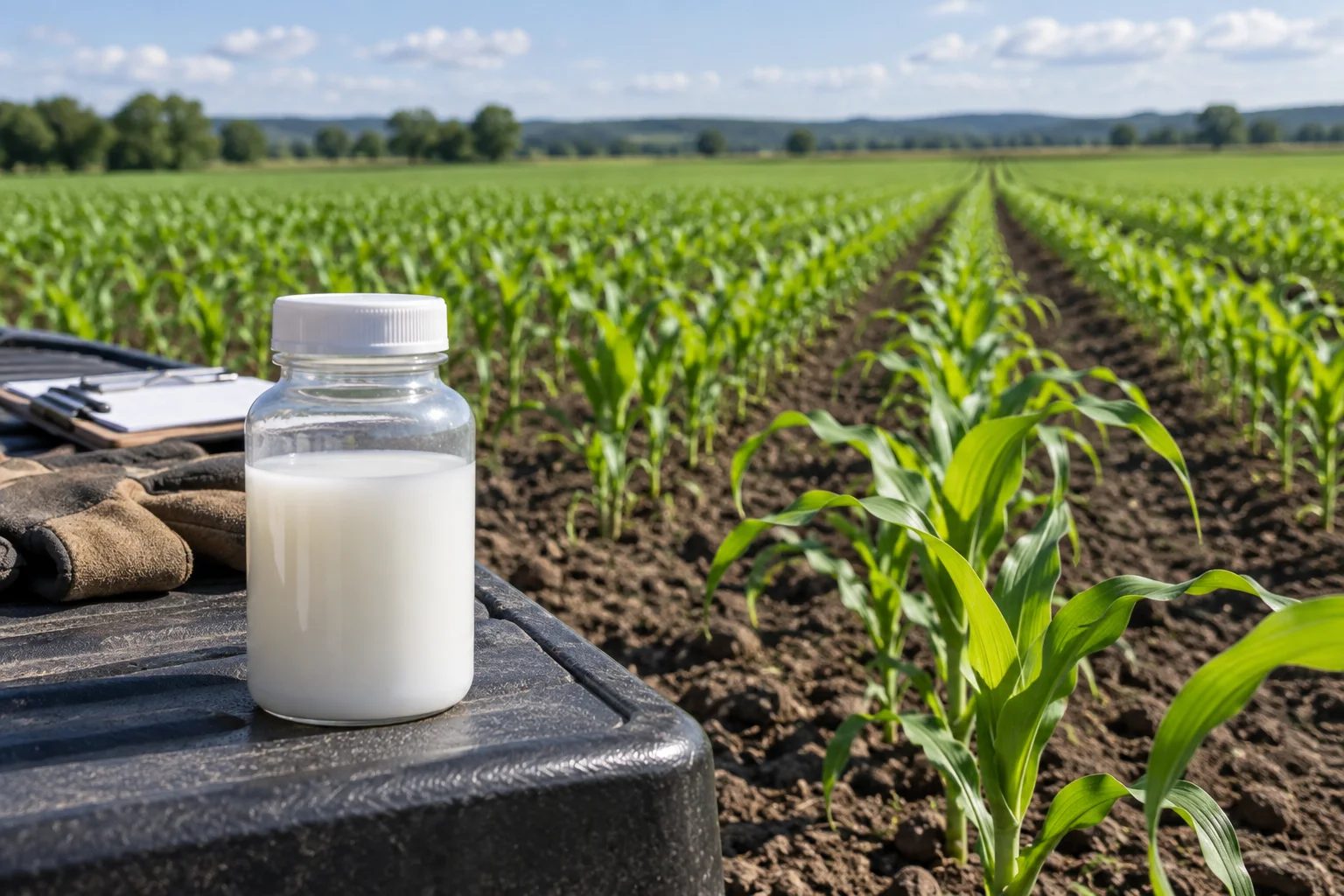
Mesotrione is a Group 27 herbicide that inhibits HPPD. For an importer, the useful comparison is not the largest number on a product title: it is the exact active-ingredient declaration, formulation, destination-market registration and batch specification. This guide compares four configurations listed by Averstar and shows what to verify before requesting a commercial offer.
What does mesotrione 40% SC tell a buyer?
The listing for Mesotrione 40% SC identifies a single-active suspension concentrate. SC describes the formulation type; it does not by itself establish crop approval, a field rate or compatibility with another product. Ask the supplier to state whether the declared 40% is on a mass or volume basis, to provide the corresponding concentration in the registered specification, and to show the exact label proposed for your market.
A percentage cannot be converted into g/L without the relevant concentration basis and, where needed, formulation density. Compare offers only after all active concentrations are expressed on the same declared basis. The quotation, certificate of analysis (COA), specification and label should describe the same formulation version.
Four listed mesotrione configurations
Straight mesotrione: Averstar lists Mesotrione 40% SC. This is the simplest option for comparing mesotrione identity and specification, but the approved crops, weeds and restrictions still come from the destination-market label, not from the catalogue title.
Mesotrione plus atrazine: the catalogue lists Mesotrione Atrazine 55% SC. The combined percentage in that title does not disclose how much of the total is each active ingredient. Request an active-by-active composition and the proposed registered label before comparing it with a straight mesotrione offer. Mesotrione and atrazine are in different HRAC groups, 27 and 5 respectively.
Nicosulfuron plus mesotrione: the Nicosulfuron + Mesotrione 40 g/L / 60 g/L OD listing states two concentrations separately and uses an oil-based suspension code. Nicosulfuron is Group 2 and mesotrione is Group 27. Compare its oil-dispersion quality data and destination label with any SC proposal; the letters OD and SC do not establish that either product is more effective for a given field.
Three-active SC: Averstar also lists S-Metolachlor + Terbuthylazine + Mesotrione 375 g/L / 125 g/L / 37.5 g/L SC. A buyer must verify all three actives, the formulation specification and the target-country registration. An additional active changes the product being assessed; it cannot be treated as an interchangeable strength of mesotrione 40% SC.
SC and OD are formulation codes, not performance promises
FAO guidance asks applicants to identify the formulation type and code using the international coding system. In that system SC is an aqueous suspension concentrate and OD is an oil-based suspension concentrate. The code tells a laboratory and a buyer which physical form is being offered; it cannot replace product-specific stability, compatibility or field evidence.
For either formulation, ask which test methods and acceptance limits apply to the exact product. Depending on the specification, the useful records may cover active content, relevant impurities, storage stability and physical properties such as suspension behavior. FAO explains that pesticide specifications support both quality control and the sale contract; a generic certificate from a different manufacturer or formulation does not verify the offered batch.
Read mixture labels before making a resistance claim
HRAC classifies mesotrione in Group 27, nicosulfuron in Group 2, atrazine and terbuthylazine in Group 5, and S-metolachlor in Group 15. Those codes make a mixture easier to describe, but multiple groups on a label do not guarantee resistance management. Each partner must be active against the target weed at the approved use pattern, and the local label and agronomic plan determine whether a mixture is appropriate.
Do not transfer a use rate, crop claim or rotation interval from one mesotrione product to another. A US EPA label for one Mesotrione 40% SC product, for example, has product-specific crop and rotational restrictions. That US label is an illustration of why the actual destination-market approval must be checked; it is not an authorization for a different product or country.
A six-part document check before quotation
1. Identity: request the full active-ingredient names, each concentration with its units and basis, the formulation code, manufacturer identity and the exact product version. Do not compare a combined 55% title with a single-active 40% title as if both numbers measured the same thing.
2. Regulatory fit: ask for the proposed label, registration holder and approval status in the destination market, including crop, weed, use pattern, restrictions and pack sizes. Confirm the current decision with the competent authority or local registrant before artwork or sales commitments.
3. Quality: request the product specification, a representative COA, relevant test methods and storage-stability evidence for the offered formulation. If FAO/WHO specifications are cited, confirm that the published specification applies to the evaluated manufacturer and product; the newer specification procedure is not a blanket certificate for every supplier.
4. Safety and logistics: obtain the current safety data sheet, packaging construction, net content, pallet plan and transport classification supplied for the exact product. Align the quotation and shipping documents with the destination requirements.
5. Sample traceability: label any sample with batch or pilot-lot identity, formulation revision and test date. Agree which analyses will be repeated on the commercial batch; a small sample alone cannot prove every later shipment will match.
6. Contract comparison: put all candidate offers on one sheet with the same units, Incoterm, pack size and documentation scope. Record open questions rather than assuming a missing entry means the products are equivalent.
A short RFQ that produces a comparable answer
State the destination country and intended crop segment, then name the exact configuration you want assessed. Ask the supplier to return an active-by-active specification, proposed local label, representative COA, SDS, packaging options, MOQ and lead time. Request the registration status and evidence separately; a product listing or draft label is not proof of permission to sell or use.
For more detail on laboratory questions, read the suspension concentrate quality guide and the FAO/WHO specification guide. Use the Averstar product links above to identify the configuration, then send an inquiry with your market and document checklist so the response can address a real procurement decision.
Frequently asked questions
Is mesotrione 40% SC equivalent to a mesotrione and atrazine 55% SC mixture?
No. One title describes a single-active product and the other describes a mixture. The 55% title does not tell a buyer each active ingredient’s share. Compare the full composition, formulation specification, registered label and intended use for the exact products. Neither catalogue title establishes local approval or a transferable field rate.
Does an OD formulation work better than an SC formulation?
The codes identify different physical formulation types, not a universal ranking of field performance. Ask for the exact product specification, stability and compatibility evidence, then check the approved label and local trial evidence for the intended crop and weed. A nicosulfuron–mesotrione OD also differs in active ingredients from straight mesotrione SC.
Which documents should an importer request before buying mesotrione herbicide?
Request the active-by-active specification, representative batch COA, safety data sheet, proposed destination-market label, registration evidence, packaging details and the manufacturer’s identity. Check that concentrations and formulation version match across documents. Local approval and use directions must be verified in the destination country before commercial supply or application.
Authoritative references
- Global Herbicide Classification Lookup - Herbicide Resistance Action Committee
- Type of formulation and code - Food and Agriculture Organization of the United Nations
- Pesticide specifications - Food and Agriculture Organization of the United Nations
- Mesotrione 40% SC accepted product label (2021) - United States Environmental Protection Agency