
Averstar Chemical Editorial Team Updated September 28, 2026
Fluopyram 98% TC vs SC: A Formulator and Importer Buyer Guide
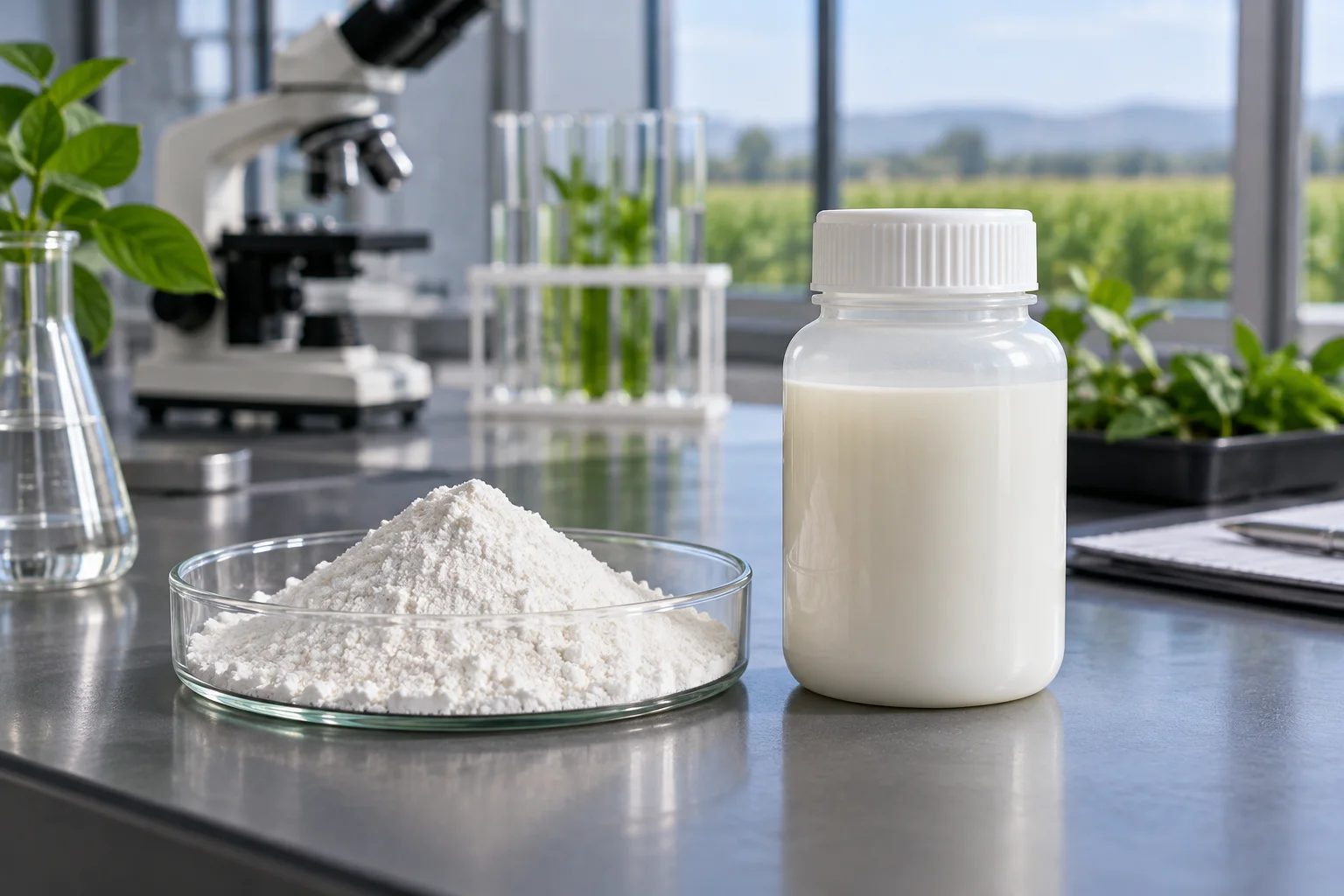
A buyer comparing “Fluopyram 98% TC” with a fluopyram suspension concentrate is comparing different stages of the supply chain. One is technical material for a formulator; the other is a formulated product with its own composition and registration path. This guide separates those questions so an importer can request the right evidence before quotation or registration work.
Start with the meaning of TC
FAO defines technical material, coded TC, as an active ingredient isolated as far as practicable from the starting materials and solvents used to make it, with associated impurities. FAO states that TC is formulated before use as a pesticide. Therefore “98% TC” is an assay statement in a technical-material title; it is not an instruction to put the material in a spray tank and it cannot be converted into a field rate.
Averstar lists Fluopyram 98% TC Fungicide as a catalogue product. A formulator considering it should request the exact assay basis, technical-material specification, relevant impurity profile, physical form, manufacturing source and current certificate of analysis. Ask which method was used for each reported result and whether the sample represents the commercial source. A single percentage in a title does not answer those questions.
Technical material and technical concentrate are also different terms: FAO uses TK for technical concentrate. Do not treat those codes as interchangeable on quotations or registration dossiers. A buyer should require the supplier to identify the actual material and state any stabilizers or other components permitted by the proposed technical specification.
How the SC listing differs
The separate Fluopyram + Tebuconazole 17.5% / 17.5% SC listing describes a two-active suspension concentrate. SC is a formulation code for a finished product type, and the title declares two active ingredients. Its 17.5% / 17.5% figures are not a lower-grade assay of the 98% TC. The formulation has its own co-formulants, quality attributes, packaging and proposed use label, all of which need review for the destination market.
FAO registration guidance distinguishes the composition of a formulated product from the identity of its technical active ingredient and the formulation process. When comparing TC suppliers for an SC project, the buyer needs a traceable link from the technical source to the formulation dossier. When buying the SC itself, the buyer needs the exact formulated-product specification and registration evidence. Neither comparison can be settled by dividing 98 by 17.5.
Check the manufacturing source and quality evidence
For a technical-material RFQ, request the manufacturer and site identity, proposed specification, representative batch COA, analytical methods, relevant impurity limits, stability or storage information and safety data sheet. Confirm whether the same source and process generated the data offered for registration. If the source changes, ask the registration specialist whether equivalence or additional data are required in the destination jurisdiction.
FAO describes pesticide specifications as tools for establishing quality criteria and supporting trade contracts. The modern FAO/WHO specification process is source-sensitive; finding a public specification for an active ingredient does not automatically certify another manufacturer’s material. State exactly which published specification, source and methods are claimed, then verify the claimed applicability before making a quality statement in a contract.
For an SC RFQ, request active-by-active concentrations and units, formulation specification, relevant physical-property and storage-stability tests, a representative COA, SDS, packaging, shelf life and proposed destination label. Confirm that these documents refer to the same manufacturing version. The technical-material COA does not replace the finished SC COA, because the two documents characterize different materials.
Use FRAC codes carefully
FRAC places fluopyram among Group 7 SDHI fungicides and tebuconazole among Group 3 DMI fungicides. The code list helps describe the modes of action in the listed SC. It does not certify that the mixture is registered for a particular crop or disease, or that it will control a local resistant population. FRAC notes resistance concerns for SDHI fungicides; obtain the approved use label and fit the product into a local disease-management plan.
A buyer should also avoid transferring a dose, crop claim or harvest interval between the technical material and formulated SC. TC has no field-use directions. A formulated product’s authorized directions are set by its own approved label in the destination country. Check the actual label before marketing, shipping for sale or planning an application.
A six-question procurement checklist
1. Which material is being quoted: fluopyram TC for further formulation, or a named formulated product? Record the complete active-ingredient composition and units. Do not use “fluopyram product” as the only description on a purchase order.
2. Who manufactures the technical source, at which site, and which source generated the analytical and regulatory data? Ask whether any manufacturing-process change affects impurity comparability or destination-country registration requirements.
3. Which specification and methods apply to the exact lot? Request representative results for active content and relevant impurities for TC, and the appropriate active-content and physical-property results for SC. Ask the supplier to identify any missing tests rather than assuming a brochure is a COA.
4. What registration evidence exists in the destination market? Request the proposed label, registrant and current approval status for a formulated product. For TC supply, identify the formulator and the technical-source data needed in the registration dossier. Verify status with the competent local authority.
5. Which safety and shipment records apply? Obtain the correct SDS, packaging construction, batch traceability, transport classification, shelf-life basis and commercial terms for the actual material. Technical material and finished SC may have different handling and packaging needs.
6. What will be tested on the commercial shipment? Agree sample identity, retained-sample procedure, COA scope and acceptance criteria before ordering. A development sample does not prove every future lot will meet an unspecified target.
Build an RFQ around the actual decision
If you are a formulator, name the destination country and intended SC project, then ask for Fluopyram 98% TC source information, specification, methods, impurity profile, sample and dossier support. If you are an importer of finished fungicide, name the exact Fluopyram + Tebuconazole SC, local registration question, formulation specification, label and batch-document scope. These are separate procurement paths with different evidence needs.
Read the technical-material equivalence guide for source-change questions and the FAO/WHO specification guide for test and document terminology. Use the product links above to identify the catalogue item, then have a local registration specialist check whether the offered source and product can be used in the target market.
Frequently asked questions
Can Fluopyram 98% TC be sprayed directly?
TC means technical material. FAO defines it as material that is formulated before use as a pesticide. Do not treat a 98% TC listing as a ready-to-apply product or infer a spray rate from the assay.
Is Fluopyram 98% TC equivalent to Fluopyram + Tebuconazole 17.5% / 17.5% SC?
No. The first is a fluopyram technical-material listing for formulation supply. The second is a two-active suspension-concentrate listing. Compare the complete composition, product specification, intended registration and use label for the exact product.
Does 98% prove the material meets an FAO specification?
No. A catalogue assay percentage alone cannot establish conformity. Request the applicable specification, methods, relevant impurity limits, representative COA and evidence tying those records to the actual manufacturing source and batch.
What FRAC groups do fluopyram and tebuconazole belong to?
FRAC places fluopyram in Group 7 (SDHI) and tebuconazole in Group 3 (DMI). These classifications describe modes of action; the suitability of a mixture and any application directions still depend on the approved label and local disease-management plan.
Authoritative references
- Technical material: terms and definitions - Food and Agriculture Organization of the United Nations
- Pesticide specifications - Food and Agriculture Organization of the United Nations
- Detailed composition of a formulated pesticide - Food and Agriculture Organization of the United Nations
- SDHI fungicides - Fungicide Resistance Action Committee
- FRAC Code List 2025 - Fungicide Resistance Action Committee